
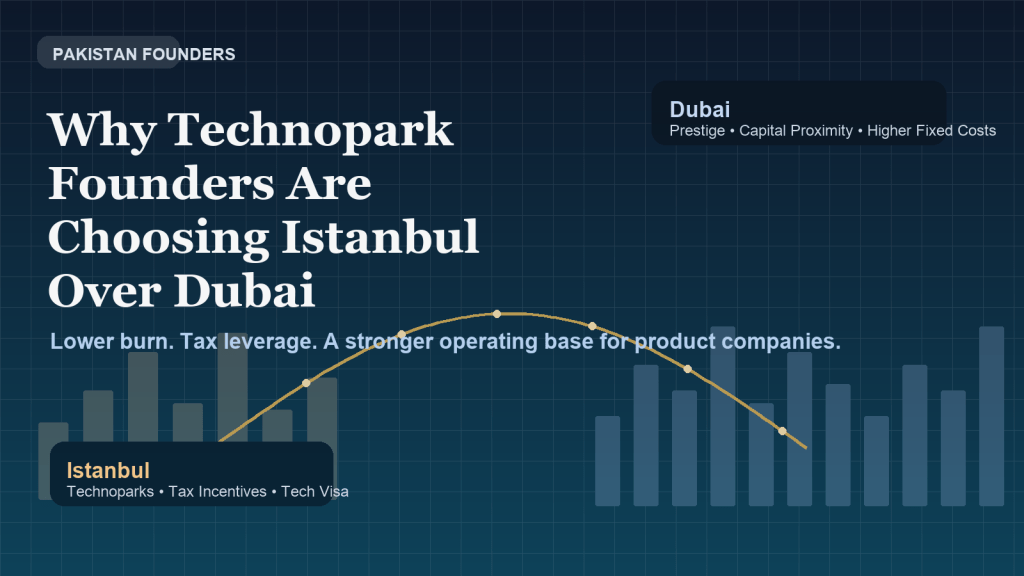
For years, Dubai has been the default answer whenever a Pakistani founder starts talking about relocation. It is the city investors know, the brand clients recognise, and the Gulf base many founders instinctively reach for when they want cleaner infrastructure, better mobility, and a more international operating environment.
But the default answer is not always the optimal one. In 2026, a growing number of Pakistani founders are looking at Istanbul more seriously, especially when the question is not status signalling but how to build a technology company with lower burn, more tax efficiency, and a more flexible route into long-term mobility.
This is where the comparison gets interesting. If your priority is pure prestige, proximity to Gulf capital, or a luxury lifestyle, Dubai still has obvious strengths. But if your priority is product building, R&D economics, hiring flexibility, and using a founder relocation move to improve your long-term strategic position, Istanbul increasingly deserves to be the first city on the shortlist, not the second.
Why This Comparison Matters More for Pakistani Founders in 2026
The pressure on Pakistani founders is not theoretical anymore. The rupee has remained fragile, with market references around PKR 278 per US dollar in June 2026, and founder planning in local currency still carries a serious forecasting problem. If your revenues, investor conversations, or talent benchmarks are increasingly dollar-linked, your base jurisdiction starts to matter far more than it did a few years ago.
That is why the Istanbul versus Dubai question is not really about lifestyle. It is about where a founder can run leaner, preserve more upside, and build from a jurisdiction that does not punish operating ambition with avoidable cost layers. The logic becomes stronger once you stop comparing social-media narratives and start comparing tax structure, office economics, payroll efficiency, and mobility pathways.
Decision lens: The right question is not “Which city looks more international?” It is “Which city gives my company the best operating geometry for the next three years?”
Istanbul’s Core Advantage Is Not Lower Glamour Cost. It Is Better Company Physics.
The strongest case for Istanbul begins inside Turkey’s technopark framework. Turkey has 94 active technoparks, with more than 8,500 companies and roughly 85,000 R&D personnel, according to foreign investment advisory reporting published in February 2026. That matters because this is not a boutique incentive regime with a handful of hand-picked firms. It is a real operating ecosystem with institutional depth.
For qualifying software, R&D, and design companies, the upside is substantial. Earnings from approved work inside a technopark can receive a 100% corporate tax exemption until 31 December 2028. Qualifying R&D personnel can also benefit from income-tax withholding exemptions, which changes payroll economics in a way that is much more meaningful than founders often realise at first glance.
There is also a practical operating point many founders miss: under the current rules, eligible personnel can still work outside the zone for up to 75% of their time through 31 December 2026 without automatically losing the tax-favoured structure. That makes the model far more compatible with modern hybrid teams than the phrase “technopark” suggests.
Dubai Is Still Efficient. It Is Just Not Automatically the More Efficient Founder Base.
Dubai remains operationally attractive for several reasons. There is no personal income tax, the city is deeply connected to investors and service providers, and incorporation pathways are familiar to many international founders. That is why Dubai continues to win when founders care most about network proximity, Gulf branding, and clean legal setup in a highly internationalised environment.
But the old “Dubai is tax free” simplification is no longer enough. Corporate tax rules changed in the UAE in June 2023, and while the burden is still modest by global standards, it is no longer accurate to frame Dubai as a zero-tax operating zone in every case. For founders comparing that to Turkey’s targeted but potentially far more aggressive technopark incentives, the gap has become more nuanced and much more case-specific.
That nuance is where Istanbul starts winning. Dubai is often simpler to explain. Istanbul is often stronger once the numbers are actually modelled.
The Burn-Rate Difference Is Big Enough to Change Strategy
One of the clearest data points in the research is cost of living. Comparative cost datasets published in late 2025 place a single person’s monthly cost in Istanbul at roughly $1,288 versus about $2,514 in Dubai. Rent is a major driver of that spread, but it is not the only one. The overall implication is simple: a founder funding personal relocation and an early team from revenue or runway will usually get materially more time from the same cash base in Istanbul.
Setup costs follow the same pattern. Turkey company formation is commonly estimated in the $1,500 to $3,000 range for a standard LLC structure, including professional fees, translation, and registration overhead. Comparable Dubai free-zone packages can range much higher, often from roughly $4,000 to over $13,000 before the founder starts layering in visas, office requirements, and premium-zone choices.
That difference does not just reduce cost. It changes the type of risks a founder can afford to take. A founder spending less on corporate scaffolding can spend more on distribution, product iteration, or better technical hires.
What this means in practice: Istanbul is not “cheap.” It is simply less likely than Dubai to force early-stage founders into high fixed-cost behaviour before the business model is proven.
Talent Economics Are Stronger in Istanbul Than Many Pakistani Founders Expect
A common assumption is that Dubai wins automatically because it is more international. But founders building technical teams should look harder at the labour equation. Dubai software compensation is materially higher, especially in better-known companies and international environments. Istanbul sits in a middle zone: more expensive than Karachi for local-market talent, but far less expensive than many Dubai hiring scenarios once you compare total employer cost.
The more important issue is not only salary. It is what the salary buys you. A founder in Istanbul can often access a deeper local ecosystem for software and R&D work than outsiders expect, while also operating inside a system that explicitly rewards innovation activity. For a company building product rather than simply routing invoices, that is a very different proposition from choosing a jurisdiction mainly because it is commercially glamorous.
Karachi remains cheaper on raw payroll for local-market hires. That part is true. But once the conversation shifts to retention, hard-currency logic, founder stability, and the quality of the operating platform, the headline salary comparison becomes less decisive on its own.
The New 2026 Foreign-Income Tax Break Makes Istanbul Harder to Ignore
One of the most consequential research findings is Turkey’s new 2026 non-dom style tax treatment referenced in June 2026 legal commentary. Under the reported framework, individuals relocating to Turkey after 1 January 2026 may receive a 20-year exemption on foreign-sourced income, subject to conditions including not having been Turkish tax resident in the prior three years.
If that interpretation holds in real implementation, it is a major strategic variable for founders who earn from overseas clients, foreign holdings, or international distributions. It does not replace proper tax advice, and it should not be marketed as a universal founder loophole. But it does mean the Istanbul decision is no longer just about cheaper living or technopark incentives. It may also affect how founders think about their personal tax architecture over a much longer window.
That is exactly why founders looking at a relocation path through the Turkey Tech Visa should treat Istanbul as a strategic jurisdiction question, not only a relocation experiment.
Mobility Is Where Istanbul Starts Beating the “Nice Office, No Path” Problem
For many Pakistani founders, the jurisdiction question is never just about where to work. It is also about where the move leads. Turkey’s founder-facing routes matter here because they can create both an operating base and a longer-term mobility story. The official Tech Visa programme now advertises a three-year work permit, simplified family residence, and access to the technopark ecosystem for eligible foreign founders and specialists.
That is a much stronger narrative than merely buying a foreign business licence and renting a desk. It gives the move institutional shape. And for founders thinking even further ahead, Turkey also remains relevant because the country still offers a defined citizenship-by-investment route through qualifying real-estate acquisition, while the standard long-term residency logic can feed into broader naturalisation planning. Founders who want to understand that long-term position properly should review the current Turkey citizenship requirements before assuming the path is either effortless or irrelevant.
Dubai still offers a cleaner prestige story. Istanbul offers more “what does this build toward?” potential.
When Dubai Still Wins
It would be lazy to pretend Istanbul wins every category. Dubai still makes better sense when your business depends heavily on Gulf-facing investor access, high-frequency regional travel into a UAE-centred network, or a client profile that reads Dubai presence as instant credibility. Some founders will also prefer its cleaner bureaucracy, stronger premium-service culture, and lower perceived volatility.
There is also a real currency and policy caveat in Turkey. The lira remains volatile. Inflation is not dead. Technopark incentives apply only to approved categories of activity, not everything a founder does. And the hybrid-work flexibility currently cited in the research is time-bound through the end of 2026, not a permanent guarantee.
So the point is not that Dubai is overrated. The point is that Dubai is often over-selected.
Who Should Choose Istanbul Now
Istanbul is the stronger choice for the Pakistani founder who is building an actual technology company, wants lower structural burn, cares about tax efficiency on qualifying work, and sees relocation as part of a longer-term strategic platform rather than a lifestyle upgrade.
It is especially attractive if your company can qualify as real software or R&D activity, if your clients are international, and if your real decision is not “Where can I open something quickly?” but “Where can I build for the next three years without carrying Dubai-level fixed costs?”
If that is your situation, it makes sense to start with a serious review of Siyah’s program pathways and then book an assessment to model which route actually matches your business profile. That is a better use of time than drifting into a relocation decision based on brand assumptions.
Work With Siyah Agents
The right answer here depends on what kind of founder you are, how your company earns, and whether you are optimising for speed, tax structure, talent, or long-term mobility. At Siyah Agents, we help founders evaluate those tradeoffs in the real world rather than through generic relocation content.
If you want to explore the most relevant route for your company, start with the website and book a strategy call through the assessment page. The quality of the move depends less on the city you admire and more on the structure you choose before you move.
Information current as of 25 June 2026. Tax, immigration, and company-setup rules can change. Incentives referenced here may apply only to qualifying activity and should not be treated as legal, tax, or immigration advice. Founders should obtain professional advice before acting.

 Siyah Agents Blog