
Most relocation content aimed at founders is either too romantic or too vague. It tells you Istanbul is exciting, connected, and strategically positioned, then quietly skips the part you actually need: what the move costs before you earn your first lira, sign your first lease, or hire your first local employee.
That omission matters because startup relocation is not one cost. It is a stack of costs with different timing, different currency exposure, and different failure points. Some are obvious, like incorporation and rent. Others are quieter but equally important, like bank-account delays, notarised translations, deposits, and the cash you lock up in the first 30 days before the move feels stable.
If you are a Pakistani founder thinking seriously about moving a tech startup from Karachi to Istanbul, the honest answer in 2026 is this: the move is affordable compared with Dubai, but it is still expensive enough that bad assumptions can damage your runway. You need a real budget, not a relocation fantasy.
Start With the Real Question: Compared With What?
The right benchmark is not whether Istanbul is cheap in absolute terms. It is whether Istanbul gives you a more useful operating platform than Karachi or Dubai for the money you will actually spend.
Compared with Dubai, Istanbul is meaningfully cheaper across setup, rent, office, and much of the founder lifestyle stack. Compared with Karachi, Istanbul is materially more expensive in pure monthly cash outflow, especially on rent and local payroll. But that higher cost buys access to a stronger relocation platform, a more internationally legible jurisdiction, and potential access to Turkish startup incentives and founder mobility routes that Karachi does not provide.
The decision becomes rational when founders stop asking, “Can I find somewhere cheaper?” and start asking, “What am I buying with the additional cost?”
The Pre-Move Setup Budget Is Usually Bigger Than Founders Expect
Research for this piece puts a standard Turkey LLC setup in roughly the $1,500 to $3,000 range once you include professional formation support, translation, notarisation, and registration overhead. That is still significantly below the cost of many Dubai free-zone packages, which commonly land somewhere between about $4,000 and $13,000 before you fully account for extras.
That sounds manageable, but founders often make one mistake here: they treat setup cost as the move. It is not. It is only the first layer. The moment you include travel, temporary accommodation, deposits, document preparation, and cash buffer, the first-month requirement moves up quickly.
For founders who qualify, the Turkey Tech Visa is especially important because it can reduce advisory friction and replace a more improvised, consultant-heavy relocation path with a more structured founder route. That does not make relocation free. It makes it less chaotic.
Budget rule: Treat the legal setup number as the entry ticket, not the full bill. Founders who budget only for incorporation nearly always under-budget the move.
Housing Is the First Serious Cash Lock-Up
In Istanbul, a one-bedroom city-centre apartment is commonly referenced around $1,100 per month in current market guides, though district choice can change that substantially. The more important point is the cash timing: first month’s rent, deposit, and agent commission can require three to four months of rent upfront. In practical terms, a founder who wants a reasonably central base can lock up around $3,300 to $4,400 before feeling properly settled.
That is the opposite of the Karachi pattern many founders are used to. Good Karachi housing can be dramatically cheaper on paper, often in the rough range of $180 to $360 per month for a one-bedroom equivalent in stronger neighbourhoods, even if quality and infrastructure reliability vary sharply. So yes, Istanbul housing is more expensive. The question is whether the improved operating environment justifies the difference.
For many founders, it does. But you should be honest that rent is not the biggest issue. Upfront rent liquidity is.
Payroll Is Where the Karachi-to-Istanbul Delta Becomes Real
Karachi remains far cheaper for local-market developer salaries. Research ranges for Karachi software engineers sit roughly between the low hundreds of dollars per month for average local-market compensation and much higher numbers for global-remote talent. Istanbul, by contrast, often puts capable tech salaries in a rough $1,200 to $3,000 monthly band depending on company type, role, and internationality.
That means a founder moving a team structure into Istanbul is not making a “save money on labour” move in the Karachi sense. They are making a “buy a different quality of operating environment and tax position” move. This distinction matters because many founders persuade themselves that relocation will lower every line item. It will not.
What it can do is reduce the hidden cost of operating from instability: FX planning friction, client perception issues, fundraising credibility drag, and weak ecosystem fit for product companies that want a cleaner R&D base.
Office and Operating Overhead Are Manageable if You Avoid Prestige Behaviour
Istanbul gives founders more room to stay flexible. Current market references put coworking desks around $150 to $500 per month, with private offices and more formal workspace costing more depending on area and setup. Compared with Dubai flexi-desks, coworking packages, and premium-zone office expectations, Istanbul still looks materially easier on early-stage cash flow.
This becomes even more relevant if your company can fit into a technopark path. That is not only a tax question. It is also an operating model question. You may be able to align workspace, incentive access, and founder credibility in one structure rather than solving them separately.
Founders should still avoid one bad instinct: copying the office aesthetics of a larger company before the business needs it. Istanbul gives you room to run lean. Use that room.
The Compliance Layer Is Small Enough to Ignore Until It Isn’t
Monthly accounting and standard compliance in Turkey are not ruinous. Research places baseline bookkeeping around $110 per month, with additional periodic filing and annual overhead layered on top. That is manageable for most serious founders. The problem is not the headline number. The problem is that founders often forget to model it alongside tax reporting, payroll administration, and the administrative demands of a more formal international operating posture.
If you are moving because you want a cleaner business base, then you need to budget for cleanliness. Cheap compliance that you fail to run properly is still expensive once it starts interfering with banking, permits, or tax filings.
That is also why it is useful to review the full range of Siyah’s program options before deciding whether you only need a company setup, or whether the right route includes residency, startup positioning, or a more structured founder programme.
The Hidden Friction Is Usually Banking, Documents, and Delay
The quietest risk in a relocation budget is not a headline fee. It is delay. Research points to two to four weeks as a realistic window for bank-account opening in many foreign-founder cases, with branch choice and document quality making a major difference. That can affect invoicing, payroll, and the founder’s psychological sense of whether the move is actually “working.”
Document handling is another repeat offender. Translation, notarisation, and apostille-related preparation can easily absorb a few hundred dollars and more than a few days. None of that is fatal. But it is exactly the type of friction founders under-budget because it sounds administrative rather than strategic.
Most underestimated cost: not the notary bill itself, but the cash and time lost while the company cannot yet operate normally.
Family Costs Can Change the Move From Sensible to Heavy
A solo founder or a couple without children can often keep the move compact. A founder relocating with a family is solving a different problem. Housing expectations change. Health cover becomes more immediate. International-school fees can become the single largest family-related expense in the entire equation.
That is why the route matters. A founder using a structured startup pathway should understand what is available through the program itself, what still needs separate planning, and what part of the move can realistically be deferred until the business base is functioning. If you are weighing a more durable residency framework rather than only the startup-entry route, it is worth reviewing how Turkey residency by investment fits into the wider landscape before making assumptions about permanence.
In other words: the move is cheapest when you sequence it intelligently, not when you rush everyone at once.
So What Does the Move Really Cost?
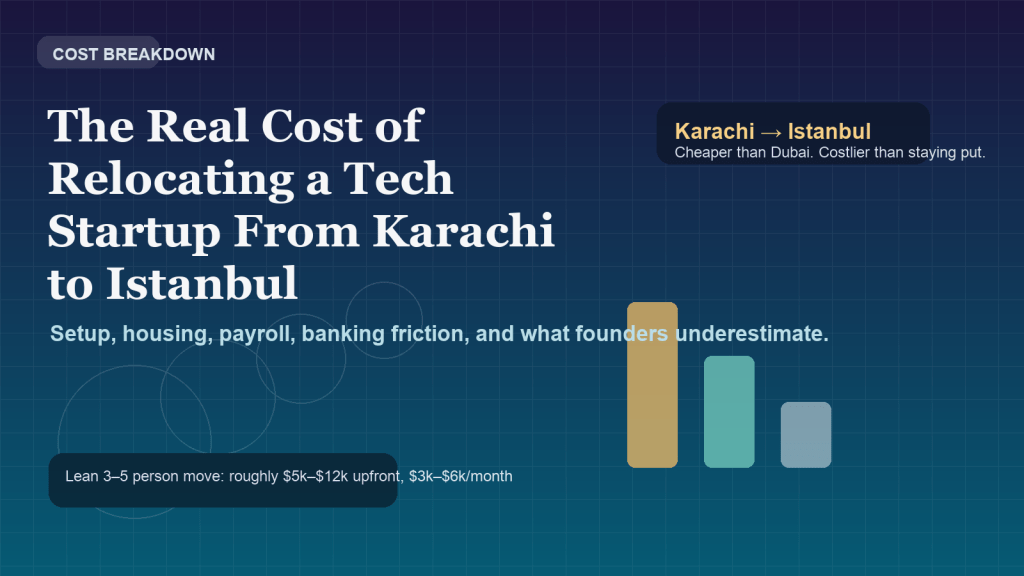
For a lean founder setup, the DeepSeek research summary is directionally useful: around $5,000 to $12,000 in one-time relocation and setup cost, and roughly $3,000 to $6,000 per month for a lean three-to-five-person operating footprint depending on housing, office style, and team composition. That is not an absolute number. It is a working range.
The right way to use that range is not as a quote. It is as a planning frame. If your move depends on the low end being exactly right, you are undercapitalised for the relocation. If you can afford the range plus a buffer, then the Istanbul option becomes much more credible as a founder base.
And if you are comparing against Dubai, that same spend often still buys you materially more runway.
When the Move Makes Sense
The move from Karachi to Istanbul makes the most sense for founders who want a more stable operating base, expect to earn internationally, can benefit from Turkey’s startup and technopark logic, and care about building an internationally legible platform without stepping all the way into Dubai’s cost structure.
It makes less sense for founders whose entire advantage is ultra-low local payroll, or whose businesses do not benefit from relocation beyond lifestyle preference. Relocation is not automatically a growth strategy. It becomes one only when the jurisdiction improves the business model.
If you are close to moving, the smartest next step is not another generic article. It is a proper budget-led review of your route, timeline, and founder profile. Siyah’s assessment process is the natural place to pressure-test whether your planned move is actually structured well enough to work.
Work With Siyah Agents
At Siyah Agents, we help founders treat relocation like an operating decision, not a mood board. That means mapping the cost stack, the permit route, the realistic timeline, and the longer-term founder upside before money is wasted on the wrong structure.
If Istanbul is on your shortlist, approach it as a build decision. The companies that relocate well are not the ones that move fastest. They are the ones that prepare the best.
Information current as of 25 June 2026. Cost figures vary by district, family size, business structure, permit path, and currency conditions. This article is for informational purposes only and does not constitute legal, tax, immigration, or financial advice.

 Siyah Agents Blog