
Living better: how EU residency elevates everyday life
Introduction: why residency is more than travel
Visa‑free movement is an obvious perk of EU residency, but the deeper value is the change in day‑to‑day life. For English‑speaking African professionals and investors, EU residency—especially through routes that lead to long‑term settlement—offers improved healthcare access, greater personal safety, broader education options for children, and a lifestyle that supports work, family and wellbeing. This guide focuses on Portugal as a clear example, outlines realistic risks and trade‑offs, and shows how to plan effectively.
Portugal: a compelling case for quality of life
H3 — Why Portugal stands out
Portugal combines a mild climate, modern services and a welcoming environment for newcomers. Cities such as Lisbon and Porto host international business communities and start‑ups, while coastal and inland towns offer quieter family life. Independent indexes and EU health and safety data routinely rank Portugal highly for safety and public health outcomes. These objective measures translate into everyday peace of mind for families and investors considering relocation.
Internal takeaway: Portugal is not just picturesque—it provides institutional stability that supports long‑term living.
Healthcare: accessible and dependable coverage
H3 — Public and private options
EU residency gives access to Portugal’s Serviço Nacional de Saúde (SNS), the public health service, which offers comprehensive care at comparatively low cost. Many residents combine SNS access with private insurance to reduce waiting times and expand choice of specialists. Official EU healthcare statistics show Portugal meets many European averages on life expectancy and infant mortality—indicators of robust systems. In practice, expect faster access to elective procedures through private plans and steady emergency care via SNS in major urban centres.
Practical note: private insurance premiums vary by age and health; budget accordingly and compare providers before arrival.
Safety and social stability: daily life without constant worry
H3 — Living in a low‑risk environment
Portugal’s low crime rates and high placement on peace indices deliver quieter neighbourhoods and safer commutes. For relocating professionals, that means reduced stress around daily routines—school runs, evening walks or local errands. Stability also supports local business confidence and predictable civic services, which matters when planning a family’s education and healthcare.
Internal takeaway: safety is a material contributor to quality of life and a decisive factor for many families.
Education: from primary through university
H3 — International and local schooling options
Portugal offers quality public education for residents and an expanding network of international schools teaching in English or IB curricula, which is especially useful for globally mobile families. Portuguese universities are increasingly active in international research and EU partnerships, offering competitively priced tuition for residents. For parents, the combined choice of public schooling and international options creates flexibility for children’s academic paths.
Practical note: early application to popular international schools is recommended; demand can outstrip supply in Lisbon and Cascais.
Lifestyle and cultural richness: everyday pleasures that add up
H3 — Health, food and leisure
Residents benefit from Portugal’s outdoor lifestyle, nutritious Mediterranean diet and extensive cultural calendar—music, festivals, historic sites and year‑round outdoor activities. Whether you prefer coastal towns or cosmopolitan hubs, the environment supports a balanced life that many investors describe as a true quality‑of‑life upgrade.
Internal takeaway: lifestyle enhancements are cumulative—better weather, food and community improve wellbeing over time.
Tax and financial planning: opportunities and caveats
H3 — Incentives and compliance
Portugal’s Non‑Habitual Resident (NHR) regime can offer tax benefits on certain foreign‑source income for a limited period, making it attractive for professionals with international income streams. Residency by investment—such as the [Portugal Golden Visa]—facilitates property and business investment under clear legal frameworks. However, tax outcomes depend on personal circumstances; double‑taxation treaties and local tax residency rules affect net liabilities.
Practical note: plan tax affairs with cross‑border advisers to quantify likely liabilities and ensure compliance.
Family inclusion and generational benefits: securing futures
H3 — Immediate and long‑term advantages
Most EU residency routes permit inclusion of spouses and dependent children, enabling the whole family to access public services and mobility across the Schengen area. Over time, residency can lead to permanent settlement and, in many cases, citizenship—bringing education, employment and healthcare options for future generations. These are durable benefits that compound across a family’s planning horizon.
Internal takeaway: residency is an investment in family opportunity and security, not just travel convenience.
Practical risks and realistic expectations
H3 — What to watch for
No programme is risk‑free. Prospective residents should model:
- Processing variability: permit timelines can range from a few months to over a year depending on route and country.
- Policy changes: investment thresholds and residency rules evolve; budget for possible increases or new conditions.
- Regional differences: healthcare quality and access can vary between urban and rural areas.
- Cost of living: while Portugal can be more affordable than many EU peers, cities like Lisbon have seen rising housing costs.
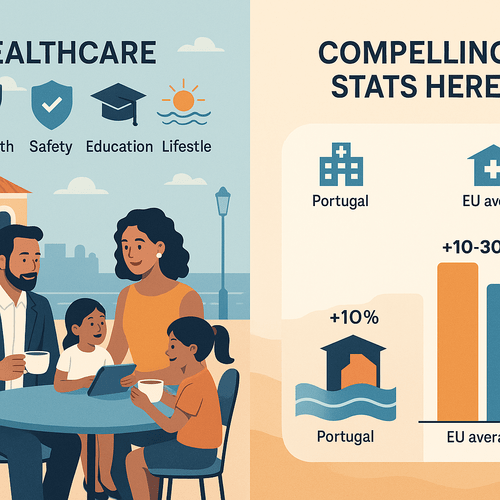
Expect ranges rather than certainties—for example, property yields or living costs may vary by ±10–30% depending on location and market cycles. When data is limited for specific applicant groups, label conclusions inconclusive and seek tailored analysis.
Comparing Portugal with other EU options: a brief note on Greece
H3 — Why compare?
Greece offers attractive Mediterranean living and its own investor routes that appeal to lifestyle‑minded families. Processing times and thresholds differ; for example, leisure‑market property options may vary between Greece and Portugal, influencing both cost and return. Evaluate both on healthcare, schooling, tax and long‑term integration—each jurisdiction carries different trade‑offs. For specific programme comparisons, examine the Greece Golden Visa and Portugal routes side by side.
Internal takeaway: country choice shapes the lived experience—match it to family priorities and business needs.
Practical checklist: planning your move to maximise quality of life
- Audit family priorities: education, health, lifestyle and business needs.
- Run tax and residency modelling with cross‑border advisers.
- Visit target regions to test daily routines and services.
- Secure local legal support for property and immigration compliance.
- Budget for private healthcare and school placements if needed.
Callout: Early planning and local insight turn aspiration into a sustainable life change.
Conclusion: take the step with expert support
EU residency—particularly in Portugal—can significantly improve daily life for professionals and investors who plan carefully. The benefits span healthcare, safety, education, lifestyle and family opportunities, but they require realistic expectations and robust planning. Start with a clear review of your aims and conditions. Explore curated options through [Siyah Agents programmes] and begin with a tailored [free assessment]. Compare flagship pathways such as the [Portugal Golden Visa] with Mediterranean alternatives like the [Greece Golden Visa] to identify the best fit for your family’s future.
Sources: Official Portuguese and EU publications; verified healthcare and safety statistics; Siyah Agents client data.

 Siyah Agents Blog