Speak to Belong: preparing linguistically for citizenship
Introduction: why language matters
Citizenship brings travel freedom, legal security and new commercial options — but most countries treat language proficiency as a test of integration, not trivia. For English‑speaking African professionals and investors, language requirements are practical hurdles you can plan for. This guide explains typical expectations, immediate preparation steps, common tests, country examples, and realistic timelines. There are no guarantees: outcomes depend on test performance, changing rules, and individual circumstances.
The role of language in citizenship decisions
Language is viewed as a proxy for integration: authorities want reassurance you can manage daily life, engage with public services, and participate civically. Requirements vary from informal interview checks to formal examinations mapped to the Common European Framework of Reference for Languages (CEFR). Expect most state tests to target A2–B1 levels for basic civic participation, though exact levels and exemptions differ by country.
Key point: language rules test practical ability — speaking and listening often matter more than theoretical knowledge.
Typical expectations: what governments look for
H3 — Practical skills over perfect grammar
Most citizenship language requirements focus on whether you can: hold routine conversations, understand public announcements, read basic official letters and complete simple written tasks. Where formal testing applies, A2 (basic user) or B1 (independent user) is the usual benchmark for naturalisation in many European systems.
H3 — Variations and exemptions
Exemptions exist for older applicants, those with certain disabilities, or individuals who have completed recognised local education. Investment routes sometimes offer relaxed initial entry rules, but citizenship applications commonly still require evidence of language competence at the naturalisation stage. Always verify exemptions with official guidance.
Assessing your level: practical first steps
H3 — Benchmark your starting point
Start with a short, standardised assessment from a recognised provider or take online CEFR screening tests. Self‑evaluation can mislead; many international professionals overestimate conversational readiness for formal tests. After benchmarking, set a realistic timeline: months, not weeks, are typically needed to bridge from basic to test‑ready proficiency.
H3 — Consider a specialist review
A focused review of your language readiness alongside your immigration plan helps identify gaps. For a confidential evaluation of language readiness and overall eligibility, try a free assessment to map next steps.
Common test formats and what they assess
H3 — The four skill areas
Most citizenship language exams assess:
- Speaking: face‑to‑face or video interview tasks simulating daily interactions.
- Listening: understanding announcements or short dialogues.
- Reading: following basic official texts.
- Writing: completing short forms or messages.
Tests typically last 30–90 minutes and prioritise clarity over complexity.
H3 — Test examples and recognition
Different states accept different exams. For Portuguese citizenship, A2 examinations such as the CIPLE are widely used; other countries use state‑designed tests or recognised language certificates. Research the specific exam accepted by your target state well in advance.
Case studies: Turkey and Portugal (what to expect)
H3 — Turkey: investment routes and language expectations
Turkey’s investment citizenship is often cited for its pragmatic approach. At present, citizenship via investment does not invariably require a formal language test; nevertheless, interviewers may assess applicants’ intent to integrate and basic communication abilities during administrative checks. Rules evolve, and some naturalisation cases outside the investment route include linguistic assessments—so confirm current criteria before committing. See practical details on Turkey citizenship if you are considering that route.
- Inconclusive: policy updates are possible; always rely on official statements or authorised advisers for the latest position.
H3 — Portugal: residency now, language for citizenship later
Portugal’s residency programmes (for example the Portugal Golden Visa) typically do not demand language ability at the initial residency stage. However, applicants seeking naturalisation after the residency period must demonstrate Portuguese at approximately A2 level. Preparing ahead avoids last‑minute pressure.
Challenges faced by English‑speaking African applicants
H3 — Common obstacles
- Underestimating oral tests: many candidates are comfortable reading English yet find spoken Portuguese or Turkish testing stressful.
- Time constraints: busy careers and family commitments reduce study hours.
- Test logistics: limited testing centres in some regions cause scheduling delays.
Practical reality: even accomplished professionals need structured, test‑oriented practice to meet CEFR targets.
Preparing effectively: a practical plan
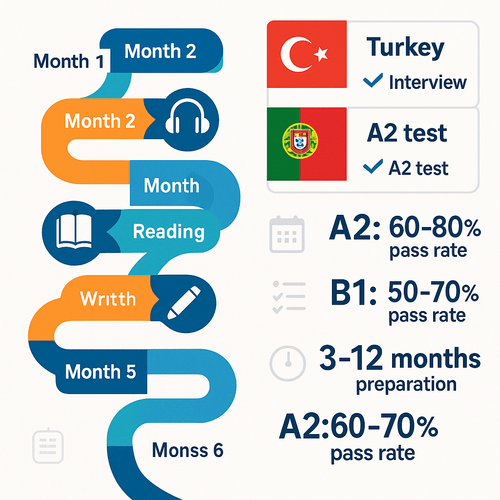
H3 — A six‑month roadmap (typical)
- Month 1: baseline CEFR assessment and goal setting.
- Months 2–3: intensive speaking and listening—focus on everyday scenarios and official forms.
- Month 4: begin mock tests under exam conditions twice monthly.
- Month 5: remediate weak areas (listening or pronunciation).
- Month 6: final mock tests and registration for an official sitting.
Adjust timelines to your starting level; some learners need 3–12 months. Aim for incremental milestones and track progress.
H3 — Resources and methods that work
- Regular conversation practice with native speakers.
- Structured courses aimed at A2/B1 citizenship exams.
- Focused listening drills (news clips, announcements).
- Mock interviews and timed writing exercises.
- Professional coaching where necessary—many migration advisers combine language coaches with immigration support. For combined immigration and test support, consider options through Siyah Agents programmes.
Test day: expectations and common pitfalls
- Arrive early and well‑rested.
- Familiarise yourself with test format and time limits.
- In speaking tests, clarity and calm matter more than complex grammar.
- If nervous, pause and structure answers: short, clear sentences win marks.
Remember: marginal differences in performance can influence outcomes; preparation reduces stress and improves chances.
What success looks like — realistic outcomes and ranges
- A2 target: many citizenship pathways accept A2; expect 60–80% pass rates among well‑prepared candidates.
- B1 target: higher standard, typically a 50–70% pass rate for dedicated candidates.
These ranges are indicative; actual pass rates depend on test provider, preparation quality and candidate profile. Outcomes are never guaranteed.
Final checklist before you book a test
- Confirm the exact exam the destination accepts.
- Complete a baseline assessment and schedule study milestones.
- Secure test centre dates early.
- Prepare all identity documents required on test day.
- Factor language preparation into your broader immigration timeline and budget.
Conclusion: plan early, prepare deliberately, seek expert help
Language requirements are a predictable, manageable part of citizenship journeys for many African professionals. Start early, prioritise speaking and listening practice, and use test‑oriented resources. If you’d like a personalised review of your immigration path and language readiness, arrange a free assessment. For full programme support combining legal, financial and language preparation, explore tailored offerings through Siyah Agents programmes. If Turkey or Portugal are on your shortlist, review country‑specific guides such as Turkey citizenship and Portugal’s residency and citizenship pathways.
Policy and test recognition can change. Always verify the current rules with official authorities or an authorised adviser before committing funds or booking exams.
Sources: Official immigration guidance from Turkey and Portugal; verified migration consultancy reports; Siyah Agents advisory data.

 Siyah Agents Blog