
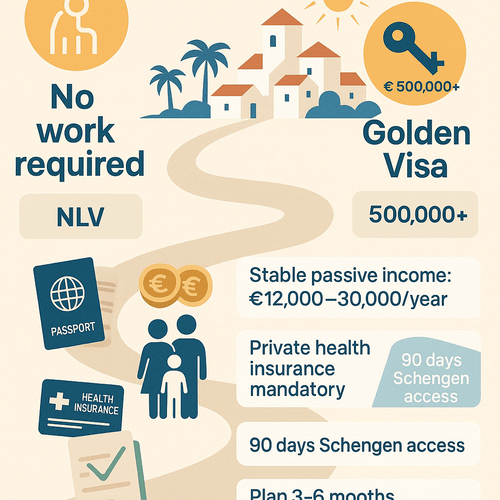
Spain’s Non‑Lucrative Visa (NLV) has become a practical route for retirees who want to live in Spain without taking employment. This guide explains the NLV’s purpose, eligibility, application steps, costs, risks and lifestyle realities so you can decide whether it suits your retirement plans. The article uses official approaches and reputable advisory practice as its basis; where policy details vary or are updated, the text flags inconclusive areas.
Why retirees choose the Non‑Lucrative Visa
Many retirees prioritise climate, culture, healthcare and predictable living costs. The NLV lets non‑EU citizens reside in Spain for an extended period without permission to work. It is designed for financially self‑sufficient people who can demonstrate stable, non‑labour income such as pensions, investment yield or other passive funds. Official Spanish immigration guidance sets the framework; independent advisers and migration reports explain how the scheme operates in practice.
Callout: The NLV is for long‑term living in Spain, not a short‑term holiday solution.
Internal summary: the NLV offers residency for financially independent retirees who can meet documentation and insurance requirements.
What the NLV actually provides: rights and limits
H3 — Residency rights
The NLV grants an initial residence permit—typically valid for one year—and can be renewed for two successive two‑year periods. After five years of legal residence, holders may apply for long‑term residency, subject to meeting legal criteria. Holders may travel within Schengen for short stays (90 days in any 180‑day period) but cannot take paid employment in Spain while the visa remains non‑lucrative.
H3 — Family inclusion and access to services
Holders can usually include a spouse and dependent children in the application. Access to public healthcare is not automatic for NLV holders on arrival; private health insurance is compulsory for the initial application and often for renewals. After establishing residency and social contributions or qualifying through specific regional rules, some residents may access public healthcare—this is context‑sensitive and, in certain regions, inconclusive depending on local practice and timing.
Who qualifies: the core eligibility requirements
H3 — Financial means: how much is enough?
You must prove that you can support yourself and dependants without working in Spain. The Spanish government uses the IPREM (Indicador Público de Renta de Efectos Múltiples) as a reference. In practical terms, consulates request evidence of income or savings equating to roughly 400% of the IPREM for the main applicant and an additional 100% of IPREM per dependant. These figures change with annual adjustments, so verify current levels at the consulate handling your application.
H3 — Health insurance and clean records
Applicants must hold comprehensive private health insurance valid in Spain with no co‑payments, and submit criminal‑record certificates from countries where they have lived. A medical certificate confirming absence of certain contagious illnesses is also required.
H3 — Proof of accommodation and no entry ban
Consulates expect evidence of accommodation in Spain and that you are not barred from entering Spain or the Schengen Area.
Internal summary: financial sufficiency, private health cover and clean background checks are the NLV’s foundational tests.
The application process: practical steps and timings
H3 — Pre‑application: document preparation
The application must be submitted from your country of legal residence at the relevant Spanish consulate. Documents usually require translation into Spanish and an apostille or legalisation where applicable. Typical documents include the completed visa form, passport, proof of funds, health insurance policy, criminal records, medical certificate and proof of accommodation.
H3 — From consulate to TIE: timeline expectations
Consular processing time varies by location but typically ranges from a few weeks to three months. On approval, you enter Spain on a 90‑day visa and must apply for your foreigner’s identity card (TIE) within 30 days of arrival. Allow a total planning horizon of 3–6 months from file submission to full registration in Spain in routine cases; complex files can take longer. These are indicative ranges based on consular practice.
Costs and financial planning: realistic ranges
H3 — Upfront and recurring costs to budget for
- Application and consular fees: typically modest (tens to low hundreds of euros) but vary by nationality and consulate practice.
- Health insurance: comprehensive private policies often range from €600–€3,000 per person annually depending on age and coverage.
- Proof of means: bank balances, pension statements or investment statements demonstrating the IPREM‑based thresholds.
- Translations, apostilles and document legalisation: budget €300–€1,000 depending on volume and languages.
- Living costs: a retiree’s annual living budget in Spain commonly ranges between €12,000–€30,000 depending on region and lifestyle.
These ranges are indicative and will depend on personal circumstances and city or region chosen.
Lifestyle and practical considerations for retirees
H3 — Healthcare and wellbeing
Private health insurance is mandatory at first, and many retirees later access public healthcare once they meet local conditions—this varies regionally and may be inconclusive in some autonomous communities without case‑by‑case checks. Specialists advise clarifying regional health rules early, and choosing a comprehensive private plan that covers emergency repatriation and chronic conditions, if relevant.
H3 — Housing, community and language
Housing costs differ markedly between Madrid, Barcelona and smaller coastal towns. Many retirees favour Andalusia, Valencia or the Canary Islands for climate and affordability. Learning Spanish is recommended to access local services and community life more fully.
Spain NLV versus Spain Golden Visa: choose by priorities
H3 — Key differences at a glance
The Non‑Lucrative Visa suits retirees who can demonstrate financial self‑sufficiency and want to live in Spain without work. The Spain Golden Visa is an investor programme (typically requiring a minimum property investment around €500,000 or qualifying capital thresholds) that permits residency with lighter physical‑presence requirements and potential work rights in some circumstances. Choose the NLV if lower capital outlay and a lifestyle focus matter; consider the Golden Visa if you prefer minimal stay obligations and can invest at required levels.
Internal summary: NLV for lifestyle and self‑funded retirees; Golden Visa for investors seeking flexibility and lower residency days.
Risks and compliance: what can go wrong
H3 — Residence lapse and tax residency risk
Spending more than 183 days in Spain may create tax residency and broader tax obligations. Conversely, insufficient presence or failing to meet renewal criteria can lead to loss of the permit. Tax implications can be material; seek cross‑border tax advice before relocating.
H3 — Insurance and healthcare gaps
A private policy that seems comprehensive in your home country may not satisfy Spanish consular requirements. Always confirm acceptability in writing with your insurer and the consulate.
H3 — Policy change and administrative discretion
Immigration rules evolve; consulates exercise discretion and interpretation. Approval is never automatic and requires careful compliance.
Callout: Non‑compliance—financial, residency or reporting—can result in refusal, revocation or deportation. Diligence is essential.
Practical tips to improve your chances
- Prepare an itemised dossier ahead of consulate appointment; don’t leave translations or apostilles to the last minute.
- Choose a private health policy that explicitly meets consular requirements and keep proof of cover when entering Spain.
- Budget conservatively for living costs and renewal evidence.
- Confirm local health access rules for retirees with a local adviser.
- Consider professional support; firms experienced in Spanish retiree visas can save time and avoid mistakes.
For structured assistance, consider checking specialised service options with trusted advisers and programmes.
Next steps and call to action
If Spain’s Non‑Lucrative Visa matches your retirement goals, begin with a careful assessment of your funds, insurance and paperwork. For a tailored review and step‑by‑step support, book a free assessment or explore full service options via Siyah Agents programmes. Detailed, up‑to‑date guidance on the NLV and alternatives can also be found in specialist briefs like [Spain Non‑Lucrative] and the [Spain Golden Visa] explanations.
Final note: the NLV can unlock a rewarding chapter in Spain, but success depends on accurate documentation, appropriate insurance and ongoing compliance. Expert advice reduces risk and helps you plan a comfortable, lawful retirement in Spain.
Sources: Spanish government immigration guidance; verified migration advisories; Siyah Agents internal experience.

 Siyah Agents Blog