
Portugal D3 Visa: a fast route for STEM talent
Introduction: why STEM professionals are watching Portugal
Portugal is raising its profile as an attractive destination for highly skilled STEM professionals. The D3 Visa — Portugal’s route for ‘highly qualified activity’ — aligns government priorities with employer demand, offering technologists, researchers and engineers a practical route to live and work in Portugal while contributing to the local innovation economy. This article explains the D3’s advantages, application realities, risks and practical next steps for STEM candidates.
What is the Portugal D3 Visa?
H3 — Purpose and scope
The D3 Visa is intended for non‑EU nationals recruited for highly qualified posts or recognised as leading experts. It focuses on roles that demand advanced qualifications and demonstrable technical expertise. Official Portuguese immigration guidance frames the visa as a tool to attract talent that strengthens Portugal’s competitiveness in science, technology and research.
H3 — Core eligibility in brief
Typical requirements include: a valid employment contract or formal job offer in a highly qualified function; recognised academic qualifications or equivalent professional experience; clean criminal record checks; proof of accommodation; and private health insurance. Exact criteria and documentary requirements are set by Portuguese authorities and may be updated, so verify current guidance before applying.
Internal summary: D3 targets articulable, demonstrable STEM skill and an employer‑backed placement in Portugal.
Why the D3 suits STEM professionals
H3 — Career advantages
STEM roles in Portugal are concentrated in fast‑growing clusters — Lisbon’s start‑up scene, Porto’s tech ecosystem and specialised research units across the country. The D3 permits professionals to take up substantive posts quickly, giving access to collaborative R&D, European projects and regional talent pools. For many, this means immediate integration into active teams, faster project delivery and exposure to EU research funding opportunities.
H3 — Family and quality‑of‑life benefits
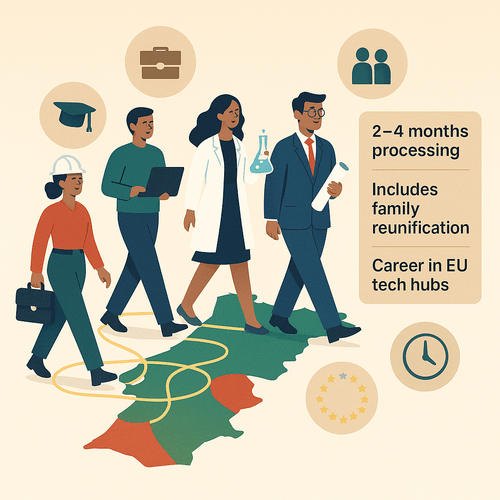
The D3 commonly supports family reunification, enabling spouses and dependent children to relocate with the primary applicant. Portugal also offers a high quality of life, affordable living compared with many EU capitals, and accessible healthcare and schooling once residency is established — considerations that help attract long‑term talent.
Callout:
The D3 is a work‑first, family‑friendly route: it connects employment with meaningful residency benefits for households.
The application process: what STEM applicants must prepare
H3 — Essential documentation
Prepare a focused dossier: signed employment contract or appointment letter; certified academic credentials and CV; detailed role description showing alignment with ‘highly qualified’ categories; police‑clearance certificates; proof of accommodation; and valid health insurance. Employers often assist with sponsor letters and local formalities.
H3 — Timeline expectations
Allow around 2–4 months for consular processing in routine cases, with additional time for credential recognition or complex clearances. Overall timelines can range from a few weeks to several months depending on the applicant’s country of origin, embassy workload and the need for academic validation. These are indicative ranges—check official sources for current processing targets.
Internal summary: be rigorous about paperwork and plan for credential recognition to avoid avoidable delays.
Rights and what D3 holders can expect
H3 — Work freedoms and mobility
Once resident, D3 holders can legally work in Portugal in their qualified field and may change employers subject to visa rules and renewals. Residence permits also enable short‑term travel within the Schengen Area (90 days in any 180‑day period). After sustained legal residence (typically several years) applicants may be eligible for permanent residence or naturalisation, subject to language and other requirements.
H3 — Family inclusion and social access
Family reunification procedures permit spouses and dependent children to apply for residence permits alongside the principal applicant, granting access to education and public healthcare after registration. Check the precise eligibility criteria and documentation required for dependants in advance.
D3 compared: D7, Golden Visa and other routes
H3 — Where D3 fits the landscape
The D3 is employment‑led; it suits professionals with job offers and advanced skills. By contrast, the Portugal D7 suits those with passive income or remote working capacity, while the Portugal Golden Visa is investment‑driven and targets capital rather than talent. Choose the route that matches your objectives: career and active work (D3), financial independence (D7), or asset investment (Golden Visa).
Internal summary: D3 is the natural choice for STEM professionals intending to work and build a career in Portugal.
Risks, uncertainties and realistic expectations
H3 — No guarantees and changing rules
Immigration regimes are subject to policy shifts. While D3 is established, documentary requirements, recognition processes and processing times can change with policy updates or administrative practice. Treat timelines and outcomes as ranges, not certainties.
H3 — Credential recognition and sector suitability
Some STEM roles require formal recognition of foreign qualifications or professional licences; this can add weeks or months to a move. Verify with the competent Portuguese recognition body whether your degree or licence needs formal recognition. This step is often decisive for clinical, engineering and regulated professions.
Callout:
Budget time and contingency: expect credential checks and embassy scheduling to extend your timeline by weeks.
Practical tips to strengthen your D3 application
H3 — Five pragmatic steps
- Secure a strong employer sponsor: employers familiar with the D3 process speed approval.
- Prepare certified translations and apostilles: official documents must be clean and current.
- Document technical impact: show how your role delivers measurable R&D, innovation or skills transfer.
- Plan family documentation early: schools and healthcare registration require time.
- Engage expert support: immigration and tax advice can prevent costly mistakes.
For structured support and end‑to‑end application management, consider tailored advisory through recognised providers and check their programme offerings, such as Siyah Agents programmes.
Career pathways and longer‑term outcomes
H3 — From residency to permanence
Many STEM professionals use the D3 as a stepping stone: initial residence, then renewal and eventual eligibility for permanent residence or citizenship after meeting residency and language requirements. Career progression in Portugal’s clusters can lead to senior roles, entrepreneurial exits or academic collaboration within EU frameworks. Outcomes vary widely; model several scenarios before relocating.
Internal summary: D3 can open multi‑year career pathways if combined with local integration and compliance.
Ready to explore your eligibility?
If you are a STEM professional considering Portugal, start with a structured evaluation. Take a free assessment to clarify eligibility and next steps. Early planning—especially around credential recognition and employer sponsorship—greatly improves the odds of a smooth move.
Conclusion: a strategic move for ambitious STEM professionals
The Portugal D3 Visa offers a credible, career‑focused route for STEM professionals seeking to work, live and grow within Europe. It links employment with family inclusion and the potential for long‑term residency, while demanding careful preparation and compliance. For tailored advice and help with documentation, employment matching and application management, consult experienced advisers who specialise in Portugal’s skilled visa pathways.
Sources: Official Portuguese immigration guidance; verified migration consultancy reports; Siyah Agents internal advisory data.

 Siyah Agents Blog