
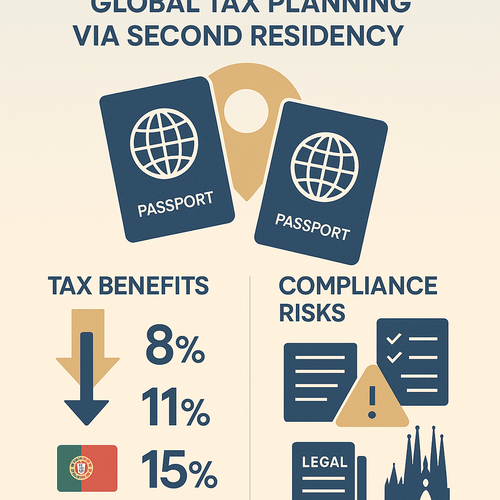
Second residency as a tax tool — a concise investor briefing
Introduction: why investors consider a second residency
Wealthy, mobile investors increasingly ask whether a second residency can legitimately improve their tax position. The short answer: sometimes — but only with careful planning, compliant structures and expert advice. This guide explains key concepts, realistic opportunities and the legal boundaries you must respect. It is written for investors weighing residency‑based strategies and who require clear, verifiable guidance rather than marketing claims.
Internal summary: second residency can enable tax planning options — not tax immunity. Decisions must be tailored, documented and compliant.
Tax residency versus citizenship: essential distinctions
H3 — What determines tax liability?
Tax liability is normally governed by tax residency, not nationality. Common tests include physical presence (often a 183‑day rule), habitual abode and centre of vital interests. Becoming a resident under a second‑residency programme does not automatically change your tax status — you must meet the destination country’s residency criteria and manage ties to your current jurisdiction.
H3 — Why the difference matters for investors
Residency affects where income, capital gains and worldwide assets are taxed. Citizenship alone rarely alters fiscal obligations. Investors must therefore design transitions that consider timing, treaty relief and reporting obligations in both jurisdictions.
Callout:
Tax residency is about presence and connections — not passport colour.
The typical tax benefits investors seek (and the caveats)
H3 — Income tax advantages
Some countries offer preferential tax regimes for new residents. For example, Portugal’s non‑habitual resident (NHR) status has, in practice, allowed qualifying new residents favourable flat rates on certain Portuguese income and potential exemptions on foreign‑sourced income for a time‑limited period. These regimes are specific in scope and conditional on compliance with local rules.
H3 — Capital gains and wealth taxes
Second residencies can support capital‑gains planning: where a jurisdiction taxes only local gains, holding foreign assets offshore may defer or reduce immediate taxation. Conversely, other countries tax worldwide gains, so outcomes depend on the interplay of both countries’ rules. Wealth and inheritance taxes also vary; certain jurisdictions offer low or zero inheritance tax for close relatives, which can aid estate planning.
H3 — Corporate tax and business structuring
Entrepreneurs may leverage residency to align company locations, treaty benefits and tax rates. This can enable lower local corporate tax exposure or more tax‑efficient holding structures. However, anti‑avoidance rules (controlled foreign company rules, transfer pricing, substance requirements) constrain aggressive planning and demand demonstrable economic substance.
Callout:
Potential benefits exist, but anti‑avoidance rules and substance tests are central to compliance.
Spotlight: Portugal and Spain — what investors commonly evaluate
H3 — Portugal (NHR and residency)
Portugal attracts investors for two reasons: the residency routes and the Non‑Habitual Resident (NHR) regime. Under NHR, qualifying individuals may be eligible for a 10‑year preferential tax treatment for certain Portuguese income and, in many cases, exemptions for foreign‑source income that is taxed abroad. Exact application and scope depend on the individual’s income type and treaty positions. Note: the NHR rules have been revised periodically; prospective residents should treat parliamentary adjustments as possible (inconclusive on future changes). See the Portugal Golden Visa as a residency route that may lead to NHR eligibility after establishing tax residence.
H3 — Spain (residency implications for investors)
Spain’s Golden Visa grants residency rights but Spanish tax law taxes residents on worldwide income. Spain also offers special regimes for certain transferees (historically the Beckham regime), though eligibility and scope are technical and limited. Investors should assume that becoming a Spanish tax resident will typically expose worldwide income to Spanish taxation unless a treaty or specific exemption applies (inconclusive on Beckham regime availability for all newcomers).
Choosing a jurisdiction: practical tax factors to weigh
H3 — Treaty networks and double tax relief
A jurisdiction’s network of double tax treaties is decisive. Treaties determine which state has primary taxing rights and the methods to eliminate double taxation. Investors should map treaty coverage for income types: dividends, interest, royalties, capital gains and pensions.
H3 — Residency tests and timing
The moment you become a tax resident matters. Many countries apply year‑long rules based on calendar or fiscal years. Migrating mid‑year can create split‑year treatment but requires careful timing of income realisation and asset disposals.
H3 — Substance and ongoing presence
Tax authorities increasingly ask whether residency is real — not nominal. Demonstrating economic substance (local office, employees, decision‑making activity) and genuine personal presence is essential to withstand scrutiny.
Compliance: reporting, transparency and common pitfalls
H3 — International reporting obligations
Residency often brings new reporting duties: asset disclosures, country‑by‑country reports for businesses, and FATCA/CRS filings. Failure to disclose can lead to penalties far exceeding any tax savings.
H3 — Avoiding the illusion of a quick fix
Second residency is not a silver bullet. Misunderstanding residency criteria, ignoring anti‑avoidance rules or underestimating reporting burdens leads to unexpected liabilities. Always test plans against both jurisdictions’ laws and seek specialist tax opinion.
Realistic ranges: what investors might expect in practice
H3 — Income tax
Some investors report effective income‑tax reductions in the range of single‑digit to mid‑teens percentage points when moving from a high‑tax jurisdiction to a preferential regime—however, outcomes vary widely by income composition and treaty relief. These figures are indicative, not guaranteed.
H3 — Capital gains and inheritance planning
Structuring for capital‑gains deferment or reduced inheritance duties can yield material benefits for families. Expected savings are highly case‑sensitive; conservative modelling and sensitivity analysis are essential.
Callout:
Model scenarios conservatively and stress‑test against policy shifts and reporting obligations.
A stepwise approach to optimise finances through second residency
- Clarify objectives: define whether income, capital, inheritance or corporate tax is the priority.
- Map residence tests: determine where and when tax residency will shift and which assets are affected.
- Assess treaty positions: confirm double taxation relief for all relevant income streams.
- Design substance: ensure operational reality matches tax positions — local offices, employees, and decision‑making presence.
- Implement staged moves: time significant disposals or income recognition to tax years that minimise exposure.
- Ongoing compliance: schedule annual reporting, audits and reviews with cross‑border specialists.
Practical advice: start with an independent review. A free assessment can surface quick wins and hidden risks before costly moves.
Risks and red flags to watch
- Sudden legislative changes that reduce or remove favourable regimes.
- Aggressive planning that triggers anti‑avoidance rules and penalties.
- Inadequate documentation of residence and economic substance.
- Misreading treaty rules leading to double taxation.
Conclusion: expert support and next steps
Second residency can be a legitimate component of sophisticated tax planning — but only when used within compliant, well‑documented structures. Investors should approach the process methodically: define objectives, test scenarios with tax and legal advisers, and plan substance as well as form. If you want a structured, independent review of residency options and tax scenarios, consider a tailored analysis through Siyah Agents. Start with a free assessment to identify suitable programmes and clarify tax implications, then progress to detailed advice for implementation.
Ready to explore residency options and model tax outcomes? Contact Siyah Agents for a tailored residency and tax review.

 Siyah Agents Blog