
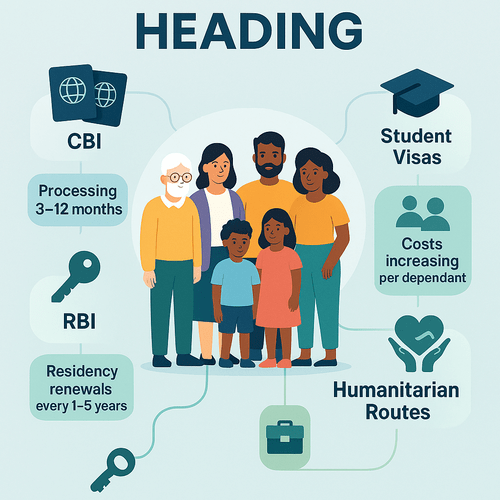
A practical guide to family-first global mobility
Introduction: family comes first
Global mobility is about more than a new passport or a property purchase; for most families it is a life decision involving schooling, work, healthcare and intergenerational security. Different mobility programmes vary sharply in how they include spouses, children and elderly dependants. This guide explains which schemes best support families, what ‘family’ usually means in law, typical timelines and costs, and practical steps to protect loved ones during relocation. All claims are grounded in official policy summaries and verified migration reporting; items flagged ‘inconclusive’ reflect areas where rules differ or change frequently.
Internal summary: map your family’s composition first, then match programmes that protect education, work rights and long‑term residency for all members.
Who counts as family? definitions and common variations
H3 — Typical family members covered
Most migration programmes explicitly include the principal applicant’s spouse or legally recognised partner, and dependent children. ‘Dependent’ commonly means under 18 or under 21/25 if in full‑time education and financially dependent, but precise age limits vary by country and visa class (inconclusive: check the destination’s policy). Some schemes permit parents or grandparents as dependants if they are financially dependent on the sponsor. Extended relatives—siblings, aunts, uncles—are rarely covered except in bespoke humanitarian or exceptional wealth programmes.
H3 — Legal relationship proofs that matter
Expect to provide marriage certificates, civil partnership records, birth certificates, adoption papers and evidence of dependency (school enrolment, bank transfers). Unmarried partners face stricter proof requirements in many jurisdictions: joint tenancy, co‑habitation evidence or long‑term shared finances are often necessary.
Callout:
Check definitions early: the word ‘dependent’ differs between legal texts and consular practice, and it is often decisive for family coverage.
Citizenship by Investment (CBI): breadth of family inclusion
H3 — Who you can typically include
CBI programmes (popular in the Caribbean and certain European states) usually offer the broadest family inclusion. Many Caribbean programmes allow the main applicant to include a spouse, dependent children (sometimes up to age 30, if studying), and dependent parents; some even permit unmarried siblings where dependency is proven. European CBI variants tend to be stricter on age and dependency but may still include parents with demonstrated need.
H3 — Costs, speed and considerations for families
CBI is fast relative to residency routes—processing can be 3–12 months in many programmes—but costs scale quickly with family size. Government fees, due diligence and legal costs typically add thousands per dependant. CBI is attractive where immediate family inclusion and rapid regularisation matter, but watch for programme rule changes and enhanced vetting in recent years (verified migration reports).
Residency by Investment (RBI) and Golden Visa schemes: family nuances
H3 — Typical family coverage and limits
Golden Visa‑style residencies (for example in parts of Europe) generally include spouse, dependent children and sometimes dependent parents. Age thresholds for children are commonly lower than in CBI schemes; evidence of enrolment in education can prolong dependency eligibility. RBI routes often require maintenance of an eligible investment for renewal, so family residency is conditional on ongoing compliance.
H3 — Mobility, schooling and work rights for dependants
RBI programmes frequently allow dependants to access local schooling and, in many cases, work rights once resident. Some countries grant full work rights to dependent spouses; others require separate work permits. Verify whether the dependant’s permission to work is automatic on issuance or requires a follow‑up application (inconclusive across jurisdictions).
Callout:
For families, RBI can provide durable residency with pathway options, but check spouse work rights and school entry terms before investing.
Student visas and family dependants: education‑led moves
H3 — Dependants under student immigration streams
Student visas can sometimes include dependants—typically partners and minor children—for postgraduate or higher‑tier study. The spouse’s ability to work varies: some countries allow full work rights for partners of international students, others restrict hours. Student routes are often cost‑effective for education‑centred families but do not always provide long‑term residency for all dependants without transition to another visa.
H3 — Practical trade‑offs
Student paths are useful when education is the primary goal, but families should plan ahead for post‑study transitions if long‑term residency or citizenship is desired. Consider whether dependants can move onto work or family routes later.
Humanitarian and family exception routes
H3 — Special measures for vulnerability and reunification
Refugee or humanitarian pathways frequently include family reunification clauses, but priority and timelines depend on national capacity and international obligations. Some countries prioritise spouses and minor children, while extended family reunification may be possible under specific humanitarian considerations. These routes are discretionary and often slower than economic channels.
Timelines and cost implications for whole‑family moves
H3 — Typical timeframes to expect
- CBI: often 3–12 months from application to final documentation for standard cases (varies by programme).
- RBI/Golden Visa: initial residency processes typically take 2–12 months; renewals recur every 1–5 years depending on the scheme.
- Student visas: usually weeks to a few months for consular processing, plus university timelines.
All ranges are indicative; political shifts and consular workloads cause variability.
H3 — Cost drivers for families
Adding dependants multiplies government fees, due diligence charges and legal costs. Expect professional and administrative fees of several thousand per additional family member in many jurisdictions; CBI programmes add materially higher government levies. Budget for translation, notarisation and certified document procurement for multiple countries of origin.
Policy variations and common pitfalls to avoid
H3 — Where families get tripped up
- Age‑related exclusions: children ageing out during processing is a common problem—time your application carefully.
- Insufficient proof of dependency: bank transfers or school records are often required to prove dependence.
- Residency-linked conditions: some schemes revoke rights if the primary investment is sold or if minimum stay rules are breached.
H3 — Mitigations
Plan early, obtain certified translations and apostilles well before application, and maintain complete financial records. Where family composition is complex, seek tailored legal advice to avoid surprises.
Practical checklist for families planning mobility
- Map your household now—and in two to five years.
- Gather certified ID, birth/marriage certificates, school records and proof of funds.
- Confirm each programme’s exact dependent definitions and age limits.
- Budget for incremental costs per dependant (govt fees, due diligence, legal).
- Verify spouse work rights and children’s school access before committing to a route.
Callout:
Early planning reduces risk: a pre‑application family audit saves time and prevents costly mistakes.
Internal summary: choosing the best family pathway
- CBI: widest family nets and speed, but higher cost per dependant.
- RBI/Golden Visas: durable residency with conditional family rights; costs and spouse rights vary.
- Student routes: education‑first options with dependent inclusion, but limited long‑term residency guarantees.
Family needs—schooling, work rights, elder care—should determine your priority, not only headline investment figures.
Conclusion and call to action: bespoke family planning matters
Global mobility can change your family’s trajectory—but success depends on matching programme mechanics to real family needs. If you want a personalised family inclusion assessment, Siyah Agents offers tailored planning that maps dependants, timelines, and costs against suitable programmes. Their advisers specialise in family migration logistics and can identify the pathway that best protects your loved ones’ interests.
Contact Siyah Agents for a confidential family audit and a clear, actionable plan tailored to your household’s goals and constraints.
Sources: Official government policy documents; verified migration programme reports; Siyah Agents family migration experience.

 Siyah Agents Blog