
Portugal’s D1 Job Seeker Visa — a pragmatic route for professionals
Introduction: why the D1 matters now
Portugal’s labour market growth, competitive cost of living and quality of life make it an attractive destination for talented professionals. The D1 Job Seeker Visa offers non‑EU/EEA nationals a legal route to enter Portugal specifically to look for work — a pragmatic alternative to relocating only after securing a contract. This guide explains what the D1 visa is, who typically qualifies, the rights it grants, likely timelines and costs, and practical steps for a successful application.
Internal summary: the D1 enables on‑the‑ground job search in Portugal. Prepare documents, proof of funds and health cover, and plan for a focused job search within the visa period.
What is the D1 Job Seeker Visa?
The D1 visa is a short‑term residence visa for skilled professionals who wish to enter Portugal to seek employment. Unlike standard work visas that require a prior job offer, D1 lets you travel to Portugal to network, interview and secure a role locally. It is aimed at those with tertiary education or recognised professional experience who can contribute to the Portuguese labour market.
Purpose and practical use
- Test the market in person and attend interviews without repeatedly applying for short‑term tourist visas.
- Build local contacts, meet recruiters and explore sectors such as technology, finance, engineering and healthcare where demand is pronounced.
Inconclusive: some authorities and advisers differ on precisely which freelance activities are permitted whilst on a D1 visa; check up‑to‑date guidance for your nationality and intended activity.
Who is eligible? Core criteria explained
H3 — Nationality and professional profile
The D1 is available to non‑EU/EEA nationals. Eligibility typically rests on a combination of academic qualifications (bachelor’s degree or higher) or demonstrable professional experience. Candidates with recognised skills in bottleneck sectors (IT, healthcare, engineering) are particularly well placed.
H3 — Financial means and health insurance
Applicants must show they can support themselves while job seeking. Practically this means providing bank statements showing sufficient funds to cover living costs during the visa period (guidance commonly suggests a level equivalent to several months’ living expenses). Comprehensive health insurance valid in Portugal is also required until local coverage is in place.
Background checks
A clean criminal record is essential; expect standard identity and background vetting. Authorities will also review documentation provenance and the plausibility of your job search plan.
Internal summary: non‑EU/EEA professionals with degrees or strong sector experience, sufficient funds and insurance are typical D1 candidates.
Residency implications: rights, duration and next steps
H3 — Rights during the visa period
While on a D1 visa you may reside in Portugal legally and actively seek employment. The visa does not automatically confer work rights until you secure a job and transition to the appropriate work or residence permit. Some limited pre‑contract activities may be possible but this is jurisdiction‑specific and should be clarified in advance.
H3 — Transition to formal residence
If you secure a qualifying job within the visa period, you can generally apply to change your status to a work‑tied residence permit. Many successful applicants use the D1 as a bridge: find work, then regularise status. If no job is found within the permitted period, you will usually need to leave Portugal or reapply, noting that repeat applications attract closer scrutiny.
Duration and renewals
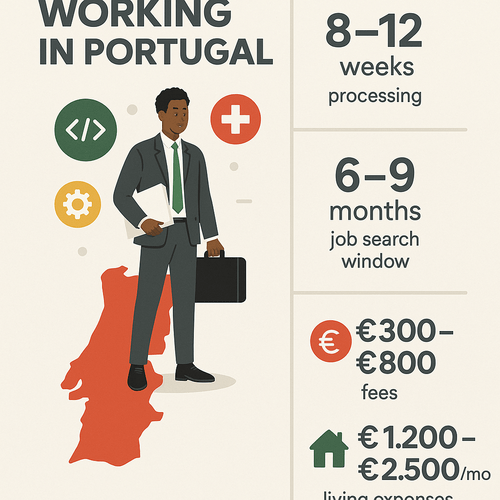
D1 visas commonly cover a period of around six to nine months for job searching; confirm the exact term for your nationality. Renewal is not automatic and depends on individual circumstances and any new supporting evidence.
Internal summary: D1 grants lawful presence to job‑seek; securing employment is essential to remain long term.
Timelines: what to expect from application to arrival
H3 — Application processing
Typical processing from consular submission to visa decision ranges widely. Many applicants should expect 8–12 weeks for processing, plus time to legalise and translate documents. Local registration and any biometric appointments after arrival add further weeks. These are typical ranges; seasonal demand and consular workload can extend times.
H3 — Job search window and conversion steps
Plan for an immediate, concerted search once in Portugal. Statistically, conversion to employment will vary by sector and language skills; tech roles with English‑language hiring cycles tend to be faster than regulated professions that require local licensing.
Internal summary: factor 2–3 months for consular processing and a concentrated job search period on arrival.
Costs: application fees and realistic budget ranges
H3 — Upfront application and paperwork costs
Expect consular fees in the low‑hundreds of euros per adult, plus costs for criminal‑record checks, document legalisation (apostille), certified translations and health insurance. Depending on your country of origin and the need for professional services, initial outlays commonly total €300–€800.
H3 — Living costs while job‑seeking
Budget for accommodation, local transport and living expenses. Monthly living costs in Portugal’s major cities typically range from €1,200–€2,500 for a single professional, depending on lifestyle and city (Lisbon and Porto skew higher). Demonstrating sufficient reserves for several months is a common consular requirement.
Internal summary: ensure you can fund at least several months’ living costs plus application fees; budget conservatively.
Practical steps to apply: a concise checklist
- Verify consular instructions for your nationality and gather the required forms.
- Prepare certified copies of degree certificates and work references; legalise and translate as required.
- Obtain a clean criminal record certificate from current country of residence and any significant recent jurisdictions.
- Compile bank statements proving sufficient funds and secure comprehensive health insurance.
- Book a consular appointment and submit the dossier; expect to provide originals and certified translations.
Tips for success
- Pre‑network with Portuguese recruiters and attend virtual events before travel.
- Learn basic Portuguese if possible — even modest competence improves job prospects and integration.
- Use a checklist and allow time for apostilles and translations — these often cause delays.
Callout: prioritise document authenticity and early translation to avoid consular delays.
Internal summary: meticulous document preparation and proactive job search prepare you to make the most of the D1 window.
Risks and practical considerations
H3 — Common causes of refusal or delay
- Incomplete or incorrectly legalised documents
- Insufficient proof of funds or unclear job search plan
- Misinterpretation of permitted activities while on the D1 (working prematurely)
H3 — Longer‑term uncertainties
Policies and administrative practice evolve; processing times and eligibility criteria can change. Always verify current official guidance close to application, and consider professional advice where your circumstances are complex.
No guarantees: securing a D1 visa improves your chances to find work in Portugal but does not ensure a job or subsequent permanent residency. Plan conservatively and maintain contingency funds and exit options.
Internal summary: manage expectations, prepare thoroughly and consider expert assistance if needed.
Conclusion: is the D1 right for your professional move?
For motivated professionals, the D1 Job Seeker Visa is a compelling bridge to Portugal’s job market: it delivers lawful entry, a defined search period and the chance to convert to employment‑tied residence. Success depends on credentials, preparation, sufficient funds and an active, targeted search strategy on arrival.
If you are considering the D1 pathway and would like tailored guidance on eligibility, documentation or job‑market strategy, consult experienced advisors to map the optimal route and avoid common pitfalls.
Call to action: For personalised advice and application support for the Portugal D1 Job Seeker Visa, contact Siyah Agents for a confidential consultation.
Sources: Portuguese government immigration guidance; verified immigration consultancy reports; sector cost indices and local living‑cost estimates.

 Siyah Agents Blog