
Introduction: why stay requirements matter
For English‑speaking African professionals and investors, residency or citizenship programmes promise mobility, business access and family security. Yet the fine print on how long you must remain in a country each year—or over a cycle of years—often determines whether a programme genuinely fits your life. This guide cuts through the complexity: compare typical stay obligations, assess lifestyle fit, weigh costs and timelines, and identify the trade‑offs that matter.
Internal summary: understanding stay rules up front avoids surprises and helps match residency to real life, not theory.
How stay requirements vary: a practical overview
Residency and citizenship programmes set stay requirements to ensure applicants have a meaningful link with the host country. Those requirements fall into three patterns: minimal presence (days per year), cumulative presence (days across several years), and substantive residence (months per year).
- Minimal presence: programmes that demand only a few days or weeks per year, often designed for investors who retain business elsewhere.
- Cumulative presence: citizenship routes that require a total number of days accrued over several years rather than strict annual thresholds.
- Substantive residence: traditional residency or naturalisation tracks that expect full‑time living (typically measured by 183 days per year in many jurisdictions).
Note: specific numbers and interpretations differ by country and pathway. Where policy varies or is updated, we mark such points inconclusive.
Internal summary: map whether the programme expects minimal, cumulative or full residence before deciding.
Typical stay ranges and what they mean for you
Below are common stay patterns you will encounter. Presenting ranges, not absolutes, helps you compare on equal footing.
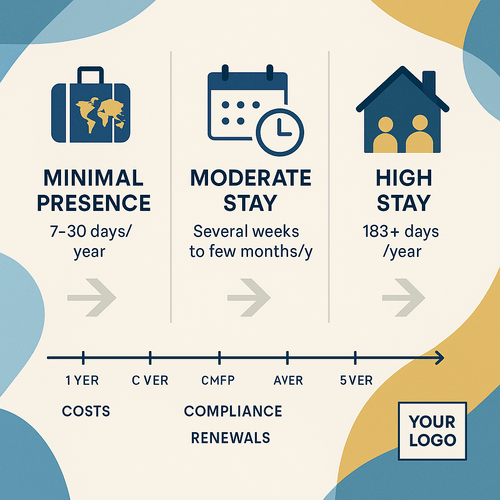
- Low‑stay investor routes: often require as little as 7–30 days per year or equivalent visits over two years. These suits owners who travel frequently and need limited physical presence.
- Moderate‑stay residency routes: commonly expect several weeks to a few months annually. These offer stronger local ties without full relocation.
- High‑stay residency or naturalisation tracks: typically require close to or over 183 days per year to be considered tax or legal residents; citizenship through naturalisation often demands continuous residence for multiple years.
Inconclusive: country‑specific thresholds and acceptable proof of presence (entry stamps, accommodation receipts, tax records) vary; always confirm with official guidance.
Internal summary: choose a target stay band that suits your professional rhythm and family needs.
Lifestyle fit: matching obligations to your life stage
Stay rules should be evaluated against your real life. Ask how each option aligns with:
- Work commitments: frequent business travel or a base in Africa argues for low‑stay programmes.
- Family needs: schooling, healthcare and spouse employment favour higher‑stay or full‑residence routes.
- Long‑term plans: if you intend to settle, higher‑stay programmes may accelerate permanent residence or citizenship.
Callout — three practical priorities to clarify now:
- Will your children attend local schools, and how many days will you need to be present for enrolment and term starts?
- Can you structure business responsibilities to permit the required visits without harming operations?
- Do you accept potential tax residency implications tied to longer stays?
Internal summary: be honest about what you can realistically commit to each year before choosing a programme.
Cost implications of stay requirements
Stay obligations carry direct and hidden costs. Consider the following:
- Travel and accommodation: frequent obligatory visits add to airfare and hotel budgets. Over a five‑year cycle, these costs can exceed programme fees in some cases.
- Time cost: trips for compliance can displace business opportunities and require delegation or travel staff.
- Compliance and legal fees: stricter stay rules often come with tighter documentation and renewed legal checks at renewal—budget for professional support.
Callout — budget checklist:
- Estimate annual travel and accommodation for required stays.
- Add professional compliance and renewal fees to your five‑year plan.
Internal summary: low apparent stay obligations can still be expensive in practice; model total cost not just headline fees.
Processing times, timing your first visits and renewal cycles
Timing matters. Many programmes require initial entry or biometrics to activate the residence clock; others allow remote application followed by an in‑country finalisation. Typical patterns include:
- Immediate‑activation routes: require an initial visit for biometrics; thereafter the clock runs. Processing may take weeks to several months depending on vetting.
- Accrual‑based routes: require you to build a cumulative number of days over a defined period (for example, five years).
- Renewal linked to investment: renewals often examine both continued qualifying investments and documented physical presence.
Inconclusive: processing speeds differ widely by jurisdiction and applicant complexity; where precise timelines are essential, obtain a current estimate from the issuing authority or a trusted adviser.
Internal summary: synchronise your first‑year travel plan with activation and renewal milestones to avoid rushed compliance.
Flexibility and business impact: operational considerations
From a business perspective, flexibility is the key metric. Low‑stay programmes enable uninterrupted operations abroad; higher‑stay options demand local management. Consider:
- Ability to delegate: do you have trusted executives who can operate in your absence?
- Mobility needs: if you attend many regional meetings, a central European or Schengen‑based residence might reduce visa friction.
- Corporate obligations: some jurisdictions require directors to hold meetings locally or maintain registered offices—check corporate law as well as immigration rules.
Internal summary: align your corporate governance and delegation model with stay obligations to prevent operational strain.
Trade‑offs and decision framework: how to choose
Selecting a programme requires clarity on priorities and realistic trade‑offs. Use this decision framework:
- Define primary objective: mobility, tax planning, family relocation, or business expansion.
- Rank the importance of physical presence, timing to citizenship, and cost.
- Shortlist options with stay patterns matching your ranked priorities.
- Run a five‑year cost and presence simulation including travel, compliance and taxes.
Callout — quick decision checklist:
- Priority: Mobility vs Integration?
- Practicality: Can you meet the required stays without business disruption?
- Cost: Do the total five‑year costs justify the benefits?
Internal summary: a short quantitative exercise clarifies which programme aligns with both lifestyle and balance sheet.
Why expert guidance matters: de‑risk your choice
Regulations change; interpretations differ and renewals attract scrutiny. Working with qualified advisers—who monitor policy shifts, check exact evidence requirements and run scenario planning—de‑risks the entire process. A tailored assessment will map your travel patterns, family needs and business commitments to the most suitable programmes and show true costs and compliance steps.
Internal summary: expert input translates policy into practical, executable plans.
Conclusion and next steps: act with clarity
Stay requirements are a practical, not academic, concern. The right programme enables freedom, not obligation; the wrong one binds you to unnecessary travel or unwelcome tax consequences. Start by defining your priorities, modelling five‑year presence and costs, and seeking a personalised assessment to confirm fit.
For a confidential, pragmatic evaluation of stay requirements across programmes and a bespoke recommendation tailored to your life and business, contact Siyah Agents for a personalised assessment and ongoing support.
Sources
- Official government residency and citizenship policies (verifiable per jurisdiction)
- Siyah Agents internal advisory data and client experience
- Recent migration investment sector reports

 Siyah Agents Blog