
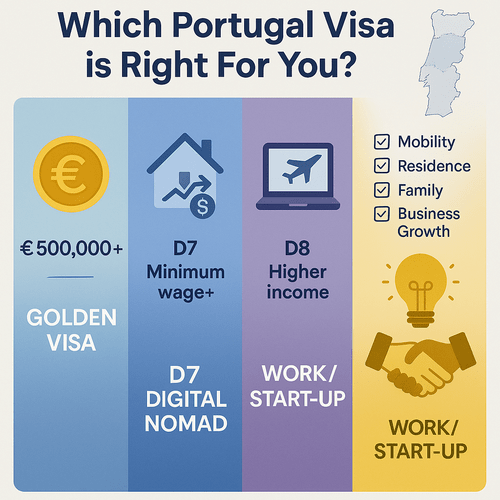
Which Portugal visa fits your goals?
Introduction: find the right gateway to Portugal
For English‑speaking African professionals and investors, Portugal is a compelling European base: excellent climate, strong international links and a range of residency routes to match different ambitions. Choosing the correct visa matters—each route balances mobility, investment, residence obligations and long‑term prospects differently. This comparative breakdown cuts through the complexity and helps you identify which option likely fits your priorities.
Internal summary: identify whether you prioritise minimal physical presence, a path from passive income, digital‑nomad flexibility or an employment/start‑up foothold.
Schengen access: the practical benefit of Portuguese residency
A principal advantage of Portuguese residence is Schengen mobility. Legal residence in Portugal permits short‑term travel across the Schengen Area (27 countries) under the standard 90/180‑day rule. For executives and investors, that translates to faster market visits, simpler family travel and less time lost to consular processes.
Practical note: Schengen travel is for short stays only. Long stays outside Portugal require national permissions from the destination country.
Internal summary: Schengen access reduces travel friction and supports rapid, pan‑European engagement.
The Golden Visa: investor residency with low presence requirements
Overview
The Golden Visa is Portugal’s flagship residency‑by‑investment route for non‑EU nationals. Historically popular with investors, it grants residence for applicants and close family in return for qualifying investments that deliver economic benefit. It is widely chosen for its low physical‑presence requirement.
Who it suits
- Global professionals who want EU access without full relocation.
- Investors seeking a formal residency route while keeping international commitments.
Qualifying investments and costs (indicative ranges)
- Capital transfers into approved funds: commonly around EUR 500,000 (varies by vehicle and fund type).
- Direct investment in Portuguese companies or job‑creation projects: typically structured from EUR 350,000–500,000 depending on the scheme.
- R&D, cultural or regional investment routes exist at lower thresholds in some categories.
Important updates and evidence notes
- Recent regulatory reforms have narrowed some real‑estate options previously used for Golden Visa qualifying investments. Confirm current eligibility with official SEF guidance or a regulated adviser—details remain subject to change.
Timelines and commitments
- Processing and documentation can take several months; realistic timelines are often 9–18 months from initial commitment to permit issuance, depending on due diligence and fund transfer timings.
Internal summary: Golden Visa offers powerful flexibility for investors but demands confirmed, qualifying economic activity and careful selection of eligible instruments.
D7 Visa: the passive‑income route for residents and families
Overview
The D7 visa targets individuals with reliable passive income—pensions, rental yields, dividends or remote salaries—and is a practical choice for professionals and retirees who plan to live in Portugal. It does not require a capital ‘investment’ in Portugal, but it does require demonstrable recurring income above government thresholds.
Who it suits
- Retirees with pensions, portfolio investors and remote professionals who expect to establish genuine residence.
Eligibility and income ranges
- Applicants generally must evidence income at least equivalent to the Portuguese minimum wage for the primary applicant (the minimum wage changes; check current figures). Additional amounts are required for family dependants.
Timelines and obligations
- Typical processing at consular stage can take 3–6 months, though times vary. The D7 requires stronger links to actual residence than the Golden Visa—expect routine checks on accommodation and finances at renewal.
Internal summary: D7 suits those willing to reside in Portugal with steady foreign income and who prioritise integration over minimal presence.
D8 Digital Nomad Visa: modern mobility for remote professionals
Overview
The D8 visa caters for location‑independent professionals earning income from sources outside Portugal. It is designed for freelancers, consultants and entrepreneurs who want extended stays without committing to full‑time local employment.
Who it suits
- Digital professionals with stable external contracts and higher monthly earnings.
Income and duration (indicative)
- Income requirements are higher than the D7 and are typically calibrated at multiples of the national minimum wage. Exact thresholds vary; check the most recent official guidance.
- The visa commonly allows initial stays up to 12 months with renewals permitted for multi‑year residence while continuing remote work.
Internal summary: D8 offers greater flexibility for remote workers who plan to live in Portugal while servicing overseas clients.
Work and Start‑up Visas: for employment and entrepreneurial founders
Overview
Portugal offers visas for sponsored workers and a dedicated start‑up visa for founders of innovative businesses. These routes require a Portuguese employer’s sponsorship or an approved start‑up endorsement, combined with evidence of skills or a viable business plan.
Who they suit
- Skilled professionals with job offers from Portuguese firms.
- Entrepreneurs building innovative ventures with potential for local job creation.
Requirements and commitments
- Work visas: require a formal job offer, proof of qualifications and compliance with labour market tests in some cases.
- Start‑up visa: typically requires endorsement from approved incubators/accelerators and a scalable, innovation‑focused business plan.
Internal summary: employment and start‑up routes are the most direct for those committed to building a local enterprise and workforce in Portugal.
Comparative snapshot: how to choose
- Golden Visa: best for investors wanting EU access with minimal time in Portugal.
- D7: ideal for those with established passive income prepared to live in Portugal.
- D8: suited to remote professionals with higher external income and desire for flexibility.
- Work/Start‑up: right for those who will be operationally present and building local teams.
Callout — decision checklist:
- Define your priority: mobility, residence, family settlement or business growth.
- Prepare documents: proof of funds or income, clean criminal record, healthcare cover and accommodation evidence.
- Confirm current thresholds: government rules change—verify before committing capital.
Risks, compliance and evidence limits
A few prudent caveats:
- Policy shifts: Portugal’s rules, particularly for investment pathways, have changed in recent years; treat property eligibility and fund thresholds as subject to revision.
- No guarantees: visa outcomes depend on document quality, genuine intent, and administrative discretion.
- Tax implications: residency can alter your tax position; consult cross‑border tax advisers.
Internal summary: adopt a compliance‑first approach and verify up‑to‑date official guidance before investing.
Practical next steps for African investors and professionals
- Clarify objectives: mobility, residence, investment returns or family relocation.
- Gather core documents: passports, bank statements, proof of income or investment, clean criminal records and accommodation proof.
- Obtain a personalised assessment from a regulated adviser to map fit and current thresholds.
Action: consult a specialist adviser for a tailored eligibility review and step‑by‑step application plan.
Conclusion: choose the route that matches your life plan
Portugal offers multiple credible pathways to residency, each with different trade‑offs. The right choice depends on whether you seek minimal presence, genuine integration, remote work flexibility, or a local business base. For a bespoke assessment and to begin your application with confidence, contact Siyah Agents for a full eligibility review and practical guidance.
Sources: Portuguese SEF official guidance; reputable migration industry reports; Siyah Agents internal programme data.

 Siyah Agents Blog