
Portugal’s Hidden Draw: why the D7 deserves your attention
Introduction: a quiet gateway to Europe
What if the gateway to Europe’s lifestyle, mobility and future security wasn’t obvious, but waiting quietly on Portugal’s sun‑baked shores? For English‑speaking African professionals and investors weighing their next move, Portugal’s D7 visa is an understated yet powerful option. It emphasises sustainable residence over headline investments — prioritising regular income, family continuity and long‑term freedom. This piece explains who the D7 suits, what it delivers, and how to begin exploring it with Siyah Agents.
Internal summary: The D7 is an income‑based residency route that favours genuine settlers — a strategic choice for professionals, remote workers and legacy‑minded investors.
The D7 visa in a nutshell: passive income, active lifestyle
Often described as the ‘passive income visa’, the D7 was originally intended for pensioners but has evolved to reflect today’s mobile professional. Rather than requiring a large capital outlay, the D7 asks applicants to demonstrate stable, regular income sufficient to live in Portugal. That income can come from pensions, rentals, dividends, remote work or salaried positions earned abroad — subject to the immigration authority’s assessment. For a detailed guide, see Siyah Agents’ Portugal D7 page: https://siyahagent.com/guides/portugal-d7-visa
Why this matters to African HNWIs
- Lower capital thresholds than many investment visas — you don’t need to purchase expensive property to qualify.
- Flexibility for remote and portfolio professionals who prefer liquidity over tying up capital in foreign real estate.
- A residency route designed for people who intend to live in Portugal and integrate, not merely to hold a travel document.
Callout: The D7 rewards genuine economic independence — in other words, show stable income, and Portugal will open the door.
Who the D7 is for: profiles that fit well
The D7 appeals to a broad set of applicants beyond retirees. Consider whether you fall into one of these categories:
- Remote professionals or digital nomads with predictable foreign income.
- Entrepreneurs and business owners who draw regular dividends or consultancy fees.
- Investors with steady passive income from portfolios or rentals.
- Families seeking a European base without the large capital outlay of investor visas.
If your priorities are lifestyle, schooling options for children and meaningful European residency rather than a quick mobility stamp, the D7 warrants serious consideration.
Internal summary: The D7 suits those prioritising residence, family stability and long‑term access to Europe over an immediate return on property investment.
Lifestyle upside: quality of life, education and healthcare
Portugal’s appeal is practical as well as picturesque. For families and professionals, the D7 unlocks more than a municipality tax number — it grants access to Portugal’s high‑quality public and private services.
Key lifestyle advantages:
- Well‑ranked public and private schools; increasing English‑language educational options in major cities.
- A broadly accessible healthcare system, with private options available for faster access.
- A safe, multicultural environment in Lisbon and Porto; quieter coastal and inland towns for those preferring low‑key living.
Schengen mobility
D7 residency establishes Portugal as your European base. While a residence permit is not the same as an EU passport, it facilitates travel within the Schengen Area — valuable for business trips, family holidays and education planning.
Callout: D7 residency turns Portugal into a platform — for business, family life and continental mobility.
Financial and procedural considerations (what to expect)
Unlike investor visas, the D7 focuses on demonstrable income rather than a single lump sum. That said, applicants must meet evidentiary standards and procedural steps. Rather than listing every numeric threshold — which vary by household and change with policy — consider these practical principles:
- Stable, legal income is essential. You will be asked to prove the source and continuity of funds (pension statements, rental contracts, dividend records, employment contracts or client invoices).
- Accommodation evidence is required. You must demonstrate suitable housing in Portugal (rental contract or property deed).
- Health cover for initial months. Applicants normally supply private health insurance at first, then may access the national system.
- Biometric and consular steps. Expect fingerprinting, document legalisation/apostille and a consular submission before travel.
Practical tip: Legalisation and translation of documents can take time. Begin preparing certified financial records and housing proof early. Siyah Agents’ assessment can pinpoint documentation gaps: https://siyahagent.com/assessment
Internal summary: The D7 process is document‑heavy but avoids a compulsory multi‑hundred‑thousand euro property purchase. Preparation is the differentiator.
D7 versus investment visas: which path fits you?
Comparing D7 with Portugal’s investor routes (such as the former Golden Visa) clarifies strategic choices.
D7 highlights
- Income‑driven rather than capital‑driven.
- Suits applicants who plan to live in Portugal and integrate.
- Potentially quicker to organise if your income proof is robust.
Investor visa highlights
- Historically allowed larger, often remote, investments such as property or fund contributions.
- Can be suitable if you prioritise lower minimum stay requirements (depending on programme) or different long‑term tax planning.
Neither route should be viewed purely as a financial product. Choose D7 if your aim is residence based on sustainable income and family life in Portugal; choose investment options if tying capital to onshore projects aligns with your broader portfolio strategy. Always check the latest official programme rules; some investment options have shifted in recent years.
Practical tips for African applicants considering the D7
- Inventory your income: prepare certified records for pensions, dividends, rental income, consultancy fees or remote employment contracts.
- Secure accommodation: a rental contract for 12 months or a purchase deed helps substantiate your intent to reside.
- Confirm health cover: arrange initial private insurance that meets Portuguese immigration standards.
- Plan for absence rules: understand minimum presence requirements if you intend to spend extended periods outside Portugal.
- Engage regulated advisers early: experienced counsel speeds preparation and reduces risk of avoidable delays.
Callout — quick checklist for readiness:
- Certified income evidence
- Rental or purchase proof
- Private health insurance for the initial period
- Translated and apostilled documents where required
How Siyah Agents helps you explore the D7 option
Siyah Agents provides tailored guidance for African professionals and investors considering Portugal’s D7 visa. Our services include:
- A confidential eligibility assessment that maps your income profile and family needs to potential Portuguese residency routes: https://siyahagent.com/assessment
- Document preparation and legal coordination, including translations, apostilles and local counsel introductions.
- Post‑arrival integration support: banking introductions, school search, and tax and estate planning referrals.
If the D7 looks promising, Siyah Agents will outline the practical next steps and estimated timelines specific to your circumstances.
CTA: Start with a confidential eligibility assessment today: https://siyahagent.com/assessment
Recap: why Portugal’s D7 is a hidden draw for African investors
- The D7 offers a residency route focused on sustainable income, not large property purchases.
- It opens access to Portugal’s lifestyle, healthcare, education and Schengen mobility.
- The route is well suited to remote professionals, retirees and investors prioritising residence and family stability.
Final thoughts and a cautionary note
Portugal’s D7 visa can be a strategic, long‑term move for African professionals seeking genuine residence and European connectivity. However, immigration rules evolve, and outcomes depend on documentation and compliance. Siyah Agents recommends careful planning, professional legal advice and an early eligibility assessment to give yourself the best chance of a smooth process.
Ready to explore the Portugal D7? Begin with a confidential eligibility assessment at: https://siyahagent.com/assessment For more contextual reading, see Siyah’s Portugal D7 guide: https://siyahagent.com/guides/portugal-d7-visa
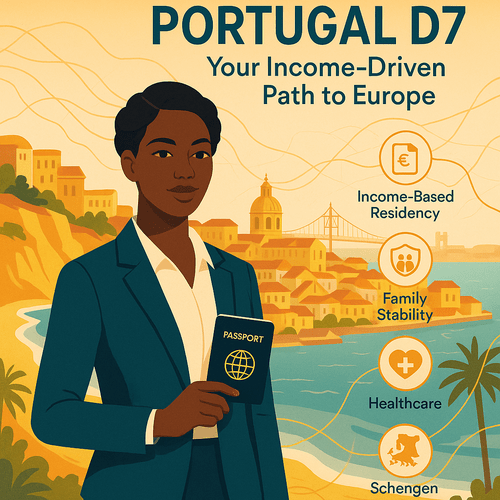
Featured image request: An elegant scene capturing Portugal’s iconic coastline or cityscape with an overlay of a confident African professional holding a passport.
Sources:
- Siyah Agents D7 programme guide — https://siyahagent.com/guides/portugal-d7-visa
- Portuguese government immigration information
- Siyah Agents internal knowledge base

 Siyah Agents Blog