Decoding Turkish CBI eligibility for Nigerian HNWIs
Introduction: why clarity matters
Imagine receiving an invitation to the world’s largest city straddling two continents — and discovering the front door may or may not be open. That uncertainty has shadowed many Nigerian high‑net‑worth individuals (HNWIs) considering Turkey’s Citizenship by Investment (CBI) programme. Conflicting headlines and social media speculation have raised urgent questions: are Nigerians still eligible? Has the pathway closed or merely tightened? This article cuts through the noise, sets out what is verifiably known, identifies ambiguous areas, and explains practical next steps for Nigerian applicants.
Internal summary: The Turkish CBI door is not formally closed to Nigerians, but due diligence, documentation and expert support are essential.
Reports of bans and restrictions: separating rumour from fact
Over the past year, social channels and some media outlets have amplified claims that Turkey has restricted or banned certain nationalities from CBI, with Nigerians frequently mentioned. These stories fall into three broad categories:
- News reports alleging increased visa denials or tighter controls.
- Social posts claiming unofficial ‘blacklists’ or nationality bans.
- Applicant anecdotes reporting longer processing times or additional document requests.
What is verifiable? There is no official Turkish government proclamation—no published regulation from the Directorate General of Migration Management or the Ministry of Interior—that expressly bars Nigerian nationals from applying for Turkish citizenship by investment. Where reports are accurate, they mainly document intensified due diligence and additional paperwork, not nationality‑based prohibition.
Callout: Treat unverified claims cautiously — check official Turkish sources and consult regulated advisers before acting.
The documented Turkish CBI investment requirements (what we know)
Turkey’s CBI programme is governed by published criteria. As of the last confirmed official guidance, the principal routes include:
- Real‑estate investment: Purchase of property worth at least USD 400,000, to be retained for a minimum of three years.
- Capital investment: A bank deposit, government bond purchase or fund investment of at least USD 500,000.
- Business investment: Establishing a business that creates a specified minimum number of jobs (often cited as 50).
- Other routes: Strategic investments meeting official thresholds and government approvals.
All applicants must pass background checks and provide clear source‑of‑fund documentation. These requirements apply irrespective of nationality. Official Turkish government portals and Siyah Agents’ programme listings remain the primary references for these thresholds.
Internal summary: The eligibility criteria are investment‑driven, not nationality‑driven; rigorous documentation is mandatory.
What is known — and what remains ambiguous
Known points
- No published nationality ban: Turkish authorities have not issued public regulations denying Nigerians access to CBI.
- Increased compliance: Turkish authorities and banks have amplified AML/KYC expectations, affecting all nationalities, including Nigerians.
- Successful Nigerian filings exist: Siyah Agents’ records and public reporting include anonymised cases where Nigerian HNWIs obtained Turkish citizenship after completing CBI requirements.
Ambiguities and areas requiring caution
- Unofficial administrative practice: Some applicants have reported extra administrative hurdles or local discretion that can extend timelines. Administrative practice can vary by regional offices, and such variance does not equal a formal ban.
- Evolving international pressure: Global financial‑crime frameworks (such as FATF) can prompt governments to adjust administrative practice quickly; these changes may not always be fully transparent during transition.
- Individual risk‑profiles: Applicants with complex compliance flags (litigation, unclear source of funds, or reputational issues) face higher rejection risk — this is a function of case quality, not nationality per se.
Checklist for ambiguity management:
- Confirm the most recent official guidance before any funds transfer.
- Use regulated intermediaries to verify local practice in the applicant’s intended region of investment.
- Prepare extra documentary evidence proactively (banking references, audited accounts, legal opinions).
Siyah Agents’ research and recent insights
Siyah Agents has tracked the Turkish CBI environment in close detail. Our key findings from client work and programme monitoring include:
- Continued approvals for compliant Nigerian applicants: Where applicants present complete, well‑documented files and transparent source‑of‑fund records, approvals continue.
- Increased requests for supplementary proof: Common supplementary items include sworn affidavits, third‑party legal opinions, and enhanced bank testamentals.
- Processing timelines vary: Cases with clear documentation can proceed within typical processing windows; others require weeks or months more when authorities seek additional evidence.
An anonymised example: a Nigerian entrepreneur with documented real‑estate funds completed purchase and provided certified bank statements, legal opinions on fund origin, and tax records; after a supplementary review, citizenship approval followed. This underscores that robust documentation, not nationality, was decisive.
Siyah Agents’ advisory recommendation: begin with a full eligibility assessment so advisers can identify any potential compliance issues and plan remedial steps before investment. Book an assessment: https://siyahagent.com/assessment
Practical steps for Nigerian HNWIs considering Turkish CBI
If you are a Nigerian HNWI assessing Turkish CBI, follow this practical roadmap:
- Obtain a formal eligibility assessment. Confirm your fit for the programme before committing capital.
- Compile exhaustive source‑of‑fund evidence. Certified bank statements, sale agreements, audited accounts and tax records reduce friction.
- Engage regulated legal counsel in Turkey. Local counsel can anticipate regional office practice variations and advise on supplementary documentation.
- Avoid premature fund transfers. Verify the latest official thresholds and procedural steps via Siyah Agents or Turkish authorities.
- Consider alternative mobility routes in parallel. If timing or documentation is problematic, EU‑oriented residencies or other CBI programmes may be viable contingencies.
Callout — Document checklist (starter):
- Certified bank statements and transaction histories
- Proof of property purchase (if applicable)
- Tax filings and audited financials
- Legal opinions on source of funds (where relevant)
Risks, limits and legal realities (no guarantees)
A frank assessment of risk is essential:
- No adviser can guarantee approval. Turkish authorities exercise discretion and policy can change.
- Administrative practice may differ locally. Regional variation in processing or additional requests can extend timelines.
- Reputation and compliance matters most. Cases with opaque funds or unresolved legal matters face higher scrutiny.
Siyah Agents emphasises an ethically robust, compliance‑first approach—applicants should expect rigorous checks and must prepare accordingly.
How Siyah Agents supports Nigerian applicants (end‑to‑end)
Siyah Agents helps Nigerian HNWIs navigate the entire CBI journey:
- Personalised assessment: Review of profile, assets and potential compliance flags.
- Document preparation and verification: Sourcing certified financial records, drafting affidavits and securing legal opinions.
- Programme selection and investment execution: Guidance on property purchase, bank deposits or qualifying investments.
- Regulatory monitoring: We track Turkish announcements and advise clients on changes that affect timing or eligibility.
Begin with a confidential eligibility assessment: https://siyahagent.com/assessment Explore detailed programmes: https://siyahagent.com/programs
Internal summary: core takeaways for Nigerian HNWIs
- There is no publicly published Turkish ban on Nigerian applicants for CBI, but procedural scrutiny has increased.
- Well‑supported, transparent applications continue to succeed; poor documentation is the primary cause of rejections.
- Use regulated advisers to pre‑empt requests and verify local administrative practice.
- Always verify current official requirements before transferring funds or signing contracts.
Conclusion & call to action
The bottom line for Nigerian HNWIs is straightforward: the Turkish CBI route remains open to well‑prepared applicants, but the tolerance for weak documentation has fallen. Rumours of nationality bans have not been substantiated by official Turkish regulations; however, administrative practice is more exacting than before. If Turkey is part of your mobility or wealth strategy, take a measured, evidence‑based approach: document thoroughly, work with regulated legal counsel and use expert advisers to manage expectations and process.
Take the next step: Book a confidential, personalised eligibility assessment with Siyah Agents: https://siyahagent.com/assessment Review Siyah’s full CBI programme options: https://siyahagent.com/programs For a private consultation, visit: https://siyahagent.com/
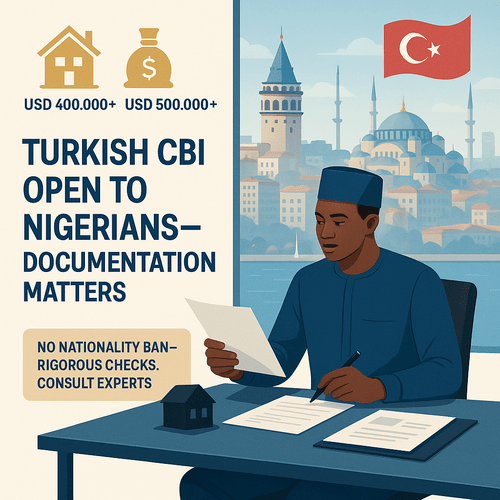
Featured image request: Nigerian investor reviewing Turkish property options with Istanbul skyline or Turkish flag subtly visible.
Sources
- Official Turkish government CBI resources (Ministry of Interior, Directorate General of Migration Management)
- Siyah Agents internal programme data and client advisory records
- OECD and World Bank migration and compliance studies

 Siyah Agents Blog