
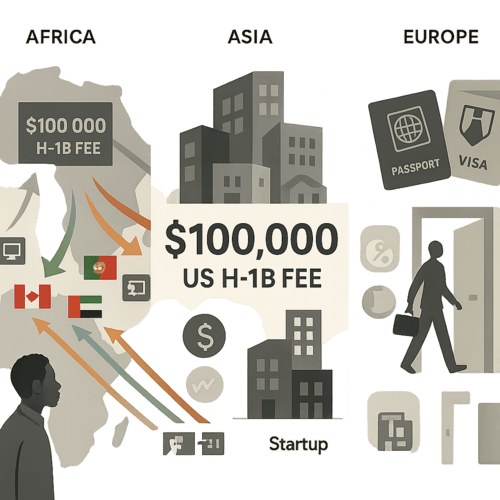
Winners and Losers of the H‑1B $100,000 Fee: What African Professionals Should Know
Introduction: the H‑1B fee shock and what it means
Imagine an immigration gate that suddenly carries a five‑figure price tag. The US policy changes discussed in 2023–24 introduce substantial employer surcharges for certain H‑1B and L‑1 petitions. For African professionals and investors, the move is more than fiscal noise: it reshapes hiring economics, market entry strategies and the global flows of talent. This piece compares who benefits and who suffers by region and sector, and outlines pragmatic responses.
Internal summary: The H‑1B surcharge raises costs for sponsors, advantages alternative destinations, and forces startups and investors to adapt global talent and market strategies.
The policy in plain terms: who pays and how much
Official USCIS updates and legislative summaries describe additional surcharges tied to employer size and visa usage. In practice: employers who exceed specified employee and visa‑ratio thresholds face added fees that can push total sponsorship costs toward the six‑figure mark in some scenarios (see USCIS guidance). Historically, H‑1B filing costs (fees and standard surcharges) ranged from roughly $1,700 to several thousand dollars depending on employer category and optional premium processing; the new policy materially widens that range.
Key points:
- The surcharge targets employers with high concentrations of H‑1B/L‑1 employees; small employers are less frequently affected.
- Legal, compliance and relocation costs remain separate — the surcharge is one part of total migration expenditure.
Source: USCIS official updates — https://www.uscis.gov/news
Winners and losers by region
Africa: constrained sponsors, new pathways
Who loses:
- Small and medium African‑founded companies that rely on US sponsorship for critical hires face disproportionate cost pressure.
- Individual candidates from African countries dependent on employer sponsorship may see fewer US offers as firms adjust budgets.
Who wins or gains opportunity:
- Countries offering transparent and cost‑effective residency or talent programmes (Canada, Portugal, UAE) attract increased interest from African professionals and founders.
Why this matters for Africa:
- African startups often operate with limited runway; an additional sponsor surcharge reduces appetite for US hires and may slow US market entry.
- Evidence in OECD migration reports shows policy shifts in major destination markets trigger talent re‑routing to alternative jurisdictions.
Sources: OECD migration policy reports; Siyah Agents programme insights — https://siyahagent.com/programs
Asia: scale players absorb, smaller firms pivot
Who loses:
- Small Asian consultancies and startups that previously supported H‑1B placements but lack balance sheets to absorb new surcharges.
Who wins:
- Large technology firms and multinational consultancies may absorb fees and remain competitive, potentially consolidating market share.
Notes:
- India, a major source of H‑1B demand, sees a differential effect: large integrators continue large-scale placements while smaller vendors face tighter margins (immigration consultancy analyses, 2024).
Sources: Immigration consultancy analysis 2024 — https://www.immigrationconsultantreports.com
Europe: diversification and opportunity
Winners:
- European tech hubs and business‑friendly residency programmes (e.g., Portugal, Ireland, Germany) could see inflows as employers and candidates seek stable, lower‑cost alternatives.
Losers:
- Some niche recruiters and small employers who relied on low‑cost sponsorship models may lose out.
Context:
- Europe’s range of startup visas and investor routes offers alternative pathways for talented professionals who no longer find the US route practical.
Source: Henley Passport Index; OECD mobility analysis
Winners and losers by sector
Large corporates and multinationals — can they weather the surcharge?
Winners:
- Deep‑pocketed corporations that require specialised talent will likely continue sponsoring selectively; the surcharge becomes a cost of doing business.
Losers:
- Cost‑sensitive departments, experimental projects and smaller business units may face hiring freezes or reprioritisation.
Implication:
- Labour strategies will shift toward fewer, higher‑value sponsorships rather than broad talent programmes.
Source: Public analyses of corporate hiring strategies; OECD labour mobility reports.
Startups and SMEs — the most exposed group
Losers:
- Early‑stage startups dependent on top external technical hires are most exposed. A $100k surcharge per sponsored hire dramatically alters burn‑rate math.
Adaptive responses (see Strategies section):
- Delay or replace sponsored hires with remote contractors.
- Establish an entity outside the US (Canada, EU, UAE) to hire locally under friendlier regimes.
Source: Siyah Agents advisory experience — https://siyahagent.com/programs
Tech and innovation sectors — mixed effects
Winners:
- Alternative ecosystems (Toronto, Lisbon, Dubai) benefit as they promote talent‑friendly visas and business incentives.
Losers:
- Some US innovation clusters risk losing diversity if sponsorship diminishes, potentially slowing cross‑border collaboration and idea exchange.
Source: OECD and immigration consultancy summaries.
How organisations and professionals are responding: practical strategies
1. Rebalancing destination strategy: Canada, Portugal, UAE and beyond
Many entrepreneurs are evaluating countries that pair efficient immigration processes with business incentives:
- Canada: Global Talent Stream and Startup Visa importantly reduce processing time and cost uncertainty (Government of Canada).
- Portugal: Residency and startup visas provide EU access and an expanding tech scene in Lisbon and Porto.
- UAE: Golden Visa and long‑term residencies for entrepreneurs are attractive for regional headquarters.
These alternatives are not identical to the US in depth or scale, but they offer predictable, comparatively lower administrative cost and family‑friendly residency options.
Sources: Government of Canada immigration pages; SEF Portugal; UAE official visa portals.
2. Remote and distributed work models
- Convert critical roles to remote contractors or hire via Employer‑of‑Record (EoR) services in the US to bypass immediate sponsorship.
- Use accelerators, partnerships and remote sales teams to maintain US market presence without local hiring.
Benefits and limits:
- Lower near‑term costs, but less control over local operations and potential compliance complexity.
3. Establishing non‑US entities or satellite offices
- Set up subsidiaries in Canada, Portugal, UAE or other business hubs to hire locally under more favourable conditions.
- Use these hubs as staging posts for future US entry when policies or company finances permit.
Siyah Agents note: These are core strategies seen among African founders who prefer staged internationalisation. Siyah Agents helps design and execute these models: https://siyahagent.com/programs
Policy nuances and uncertainty: read the small print
- Fee applicability depends on employer size and visa composition — not every sponsor pays the surcharge.
- Final regulatory texts and legal challenges may change implementation timelines and thresholds.
Action point: Keep monitoring official USCIS announcements and consult immigration counsel before budgeting for US expansion.
Source: USCIS official updates — https://www.uscis.gov/news
Regional summary: winners, losers and opportunities at a glance
- Africa: Loses in US sponsorship access; gains in alternative destination interest and remote business models.
- Asia: Large firms absorb costs; smaller vendors face pressure.
- Europe: Opportunity to attract displaced talent; recruiters must adapt.
Sector snapshot:
- Large corporates: Better positioned to absorb costs.
- Startups/SMEs: High exposure and need rapid pivoting.
- Tech/innovation: Risk of reduced cross‑border flows; opportunity for alternative hubs.
Why African professionals should act decisively now
The fee environment adds a new layer of strategic planning for African founders: balancing runway, talent needs and market access. Steps to consider immediately:
- Run a full cost model for US sponsorship vs alternative routes.
- Trial remote or contractor models for critical functions.
- Assess eligibility for alternative residency or talent programmes with trusted advisers.
Siyah Agents CTA: Start with a personalised eligibility assessment and programme matching to plan the best route for your business: https://siyahagent.com/assessment Explore tailored programmes: https://siyahagent.com/programs
Conclusion: policy shocks reshape, but do not end, global opportunity
The H‑1B surcharge alters the calculus for sponsors and candidates. It advantages destinations with predictable, affordable entry routes and firms with deep pockets. Yet it also accelerates inventive adaptations—remote models, regional hubs, and new migration flows. For African professionals and investors, the pragmatic path is to diversify options, plan with experts, and treat this change as an inflection point rather than a dead end.
Begin your strategic migration plan with Siyah Agents: book a discovery call or eligibility assessment and explore programme options to secure your global ambitions: https://siyahagent.com/assessment and https://siyahagent.com/programs
Sources
- USCIS official updates — https://www.uscis.gov/news
- OECD migration policy reports — https://www.oecd.org/migration
- Immigration consultancy analysis 2024 — https://www.immigrationconsultantreports.com
- Siyah Agents programme insights — https://siyahagent.com/programs
- Henley Passport Index — https://www.henleypassportindex.com/

 Siyah Agents Blog